Tuesday, 1 January 2013

The Year Of The Higgs, And Other Tiny Advances In Science

Scientists at the Large Hadron Collider announced the discovery of the Higgs boson on July 4, the long-sought building block of the universe. This image shows a computer-simulation of data from the collider.

Barcroft Media/Landov Scientists at the Large Hadron Collider announced the discovery of the Higgs boson on July 4, the long-sought building block of the universe. This image shows a computer-simulation of data from the collider. Scientists at the Large Hadron Collider announced the discovery of the Higgs boson on July 4, the long-sought building block of the universe. This image shows a computer-simulation of data from the collider.

Barcroft Media/Landov

It's a year-end tradition to cobble together a list of the most important advances in science. But, truth be told, many ideas that change the world don't tend to spring from these flashy moments of discovery. Our view of nature — and our technology — often evolve from a sequence of more subtle advances.

Even so, chances are good that this year's list-makers will choose the discovery of the Higgs boson as the most important discovery of 2012.

The Higgs is a long-sought building block of the universe. It finally put in an appearance at an accelerator in Europe. But though it was big news, it wasn't apparently a revolutionary discovery.

"There are certainly a number of physicists who are actually disappointed," says Sam Arbesman, a scientist and mathematician at the Kauffman Foundation. "They were hoping to find something a little different from what all the models predicted."

Monday, 31 December 2012

Research Moratoriums And Recipes For Superbugs: Bird Flu In 2012

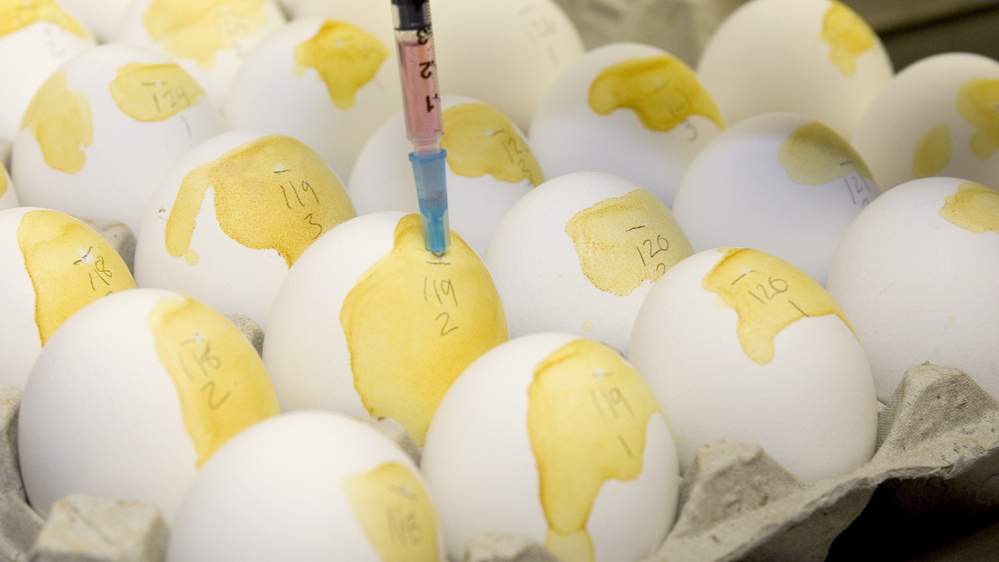
Researchers at the U.S. Geological Survey National Wildlife Health Center in Madison, Wis., use eggs to see if the Asian strain of the H5N1 bird flu virus has entered the U.S. in this photo from 2006.

Andy Manis/AP Researchers at the U.S. Geological Survey National Wildlife Health Center in Madison, Wis., use eggs to see if the Asian strain of the H5N1 bird flu virus has entered the U.S. in this photo from 2006. Researchers at the U.S. Geological Survey National Wildlife Health Center in Madison, Wis., use eggs to see if the Asian strain of the H5N1 bird flu virus has entered the U.S. in this photo from 2006.

Andy Manis/AP

For scientists who study a dangerous form of bird flu, 2012 is ending as it began — with uncertainty about what the future holds for their research, but a hope that some contentious issues will soon be resolved.

Last January, dozens of flu experts around the world agreed to what was supposed to be a 60-day pause in controversial experiments on the H5N1 bird flu virus. But none of them resumed work as planned because all year long, the debate over the benefits and the risks just wasn't going away.

Virologist Ron Fouchier of Erasmus Medical Center in the Netherlands says he reluctantly went along with the moratorium, "but I've not been a great advocate of it because there is urgency in this type of research."

Fouchier gets funding from the National Institutes of Health to study H5N1, which is widespread in poultry in parts of Asia and the Middle East.

H5N1 rarely infects humans, but more than half of those known to have gotten sick with it have died. Scientists have long wanted to know if this bird flu could mutate in a way that could make the virus start spreading between people and cause a pandemic.

Why Charities Need To Consider Donors' Politics

As American make contributions to various charities at the end of the year, there is increasing evidence that politics is playing a role in their decisions. Research suggests that the way the charity presses certain ideological buttons predicts whether liberals or conservatives will pony up a donation.


View the original article here

Sunday, 30 December 2012

Despite Uneven Results, Alzheimer's Research Suggests A Path For Treatment

Brain scans using Amyvid dye to highlight beta-amyloid plaques in the brain. Clockwise from top left: a cognitively normal subject; an amyloid-positive patient with Alzheimer's disease; a patient with mild cognitive impairment who progressed to dementia during a study; and a patient with mild cognitive impairment.

Brain scans using Amyvid dye to highlight beta-amyloid plaques in the brain. Clockwise from top left: a cognitively normal subject; an amyloid-positive patient with Alzheimer's disease; a patient with mild cognitive impairment who progressed to dementia during a study; and a patient with mild cognitive impairment.

Slide courtesy of the journal Neurology

It's been a mixed year for Alzheimer's research. Some promising drugs failed to stop or even slow the disease. But researchers also found reasons to think that treatments can work if they just start sooner.

Scientists who study Alzheimer's say they aren't discouraged by the drug failures. "I actually think it was a phenomenal year for research," says Bill Rebeck, a brain scientist at Georgetown University.

Rebeck is optimistic because during the year, several very different lines of research all began to suggest a new way of thinking about Alzheimer's — that it has to be stopped before it damages the brain.

"Once you start to lose a lot of synapses, once you start to lose a lot of neurons, your brain can't recover from that," Rebeck says. "And so when we start with people who have symptoms of the disease, treating them turns out to be unsuccessful."

That explanation comes in part from studies that used a new research tool approved by the Food and Drug Administration in April. The tool is a drug called Amyvid that's injected into the bloodstream and travels to amyloid plaques in the brain. Those are the plaques associated with Alzheimer's.

The dye, also called florbetapir, lets researchers detect even tiny plaques using a positron emission tomography, or PET, scanner.

"In the PET scan you can see whether somebody has amyloid in their brain...before [they show] symptoms of the disease. I think that's huge," Rebeck says.

Researchers have already used the technique to show that amyloid begins to build up decades before people start having problems with memory or thinking. Rebeck says it should also provide a much quicker way to gauge whether a new Alzheimer's treatment is working.

Another advance this year was a study showing that the brain begins to function differently long before symptoms of Alzheimer's appear.

Lori Beason-Held of the National Institute on Aging presented the study at the Society for Neuroscience meeting. She says previous research had found brain changes among people in the early stages of Alzheimer's.

"Our study has gone back even further and discovered changes in the brain that occur up to 11 years before any symptoms occur in individuals who eventually become cognitively impaired," says Beason-Held. And the changes probably start even earlier, she says.

That might sound discouraging, but Rebeck doesn't see it that way. "What that says is there's an opportunity, there's a window when if we could stop that amyloid from accumulating, or start to clear it out of the brain, then you could prevent those symptoms from actually ever happening," he says.

Another study this year suggests a way to do that. Researchers in Iceland discovered that families with a rare gene mutation are much less likely to get Alzheimer's. The mutation appears to interrupt a key step in the formation of amyloid.

In order to form amyloid, the brain has to first cut up a larger molecule, explains Robert Vassar of Northwestern University. That step requires an enzyme called beta-secretase or BACE 1.

"BACE 1 is like a pair of molecular scissors, and what the mutation does is sort of interfere with the way the molecular scissors can cut. It sort of like, dulls the blades," Vassar says.

Just a few months ago researchers came up with a drug that does the same thing that the gene mutation does naturally, says Rebeck. This drug, though, may have to be administered before amyloid has begun to build up.

Michael Raffi, of the University of California, San Diego, says the new thinking about amyloid and Alzheimer's is a bit like the current approach to cholesterol and heart disease. Doctors don't wait until someone has a heart attack before putting them on drug that lowers cholesterol.

"Really the ideal situation is to have checked their cholesterol levels 15 years prior, and seen whether it was elevated, which would imply that they have an elevated risk of having the heart attack, and starting the medication then," Raffi says.

It's still not clear, though, whether amyloid is the new cholesterol. "It took a long time for us to make that connection between cholesterol and heart disease," says Rebeck. "That's been very successful. It's been very helpful in so many people's lives. We're just [at] earlier stages in studying Alzheimer's disease."


View the original article here

Birds Hang Around Mistletoe For More Than A Kiss

Researchers in Australia found that when they removed mistletoe from large sections of forests, vast numbers of birds left.

Researchers in Australia found that when they removed mistletoe from large sections of forests, vast numbers of birds left.

BSIP/UIG via Getty Images

For the Druids, mistletoe was sacred. For us, it's a cute ornament and maybe an excuse to steal a kiss. And of course it's a Christmas tradition.

But for a forest, mistletoe might be much more important. It's a parasite, shows up on tree branches and looks like an out-of-place evergreen bush hanging in the air.

Its seeds drill through bark with a threadlike probe and then grow by sapping the energy of its host. And certain types can be nasty pests, especially dwarf mistletoe in the American West.

But it may actually be useful, and more than just as an excuse to make out with someone.

David Watson, an ecologist at Charles Sturt University in Australia, had long suspected this. But nobody had really proved it experimentally. So he did an experiment in an Australian forest.

He just took the mistletoe out.

"Me and a team of 12 volunteers in cherry pickers" — he recalls — "we removed just over 41 tons of mistletoe."

It took five months and then another visit the next season to get it all out.

Three Years Later ...

"The simple act of removing mistletoe led to losses of over a third of the woodland dependent species [of bird]," Watson says. All these birds just left. And weirdly, the birds that took the biggest hit were insect-eating birds.

"Especially the ones that eat insects on the forest floor," Watson says.

What do insects have to do with mistletoe? "It's a byproduct of how parasitic plants do their parasitizing," explains Watson. Parasitic plants are packed with nutrients that they gobble up from their hosts. They suck up all these salts and minerals to create a water gradient between them and their host so they can draw water out of their hosts.

"Parasitic plants the world over have 15 [to] 20 times more concentrated nutrients than their hosts," Watson says.

And because they're moochers, they don't really care about conserving their resources — they can just suck out more. Not so with regular trees, which pull out the good stuff from their leaves before allowing them to fall. But mistletoes just drop their leaves with all the vitamins inside.

"So there is this rain of enriched litter — a bit like mulch, a fertile mulch," as Watson puts it, that falls onto the forest floor under infected trees.

More goodies on the soil, more bugs, more birds that eat the bugs — it might mean more lizards and more mammals too, says Watson. Because of the apparently significant and widespread effects of mistletoe on a forest, he calls it a "keystone resource." He published earlier this year in the Proceedings of the Royal Society B: Biological Sciences.

Brian Geils, a retired forest pathologist for the U.S. Forest Service, says the jury is still out. As to whether mistletoe in the United States improves forest biodiversity in the way that it appears to in Australia, dwarf mistletoe in the Western U.S. doesn't have the same amount of leaf litter. And that particular type of mistletoe can kill trees. So he's hesitant to credit the parasitic plants with a blanket mantle of positive effects.

"It's quite complex to come up with a simple good or bad, more or less," Gelis says

Even so, he does agree that mistletoe has, for its size, a lot of bang for its buck in a forest ecosystem. For example, he says, it can cause some conifers to grow into what are known as "brooms" — strange-looking, twiggy, bushy poles that can act as ladders for fire and that attract a population of insects not normally found in the canopy.

Daniel Nickrent, a professor of plant biology at Southern Illinois University, is convinced mistletoes do have a similar role in North American forests as they do in Australian ones, particularly the phoradendron mistletoe found in the Eastern U.S.

"So does this keystone idea apply to some of the North Americans ones? I think they do," Nickrent says. "There's evidence they do."

Endangered snowy owls, for example, prefer to nest even in the pathogenic dwarf mistletoe. And, Nickrent says, some mistletoes appear to expand the fungal community that lives in soil beneath infected trees. The biggest instances of tree death by mistletoe aren't in natural forests but rather in human-created groves for lumber.

"This is like a beautiful petri dish that's not inoculated yet," he says of the large tree plantations that can be so afflicted by dwarf mistletoe. They're "just waiting for the mistletoes to come in and feed on this. So the human-altered ecosystems are heavily damaged by dwarf mistletoes."

However you look at mistletoe — keystone font of diversity or pathogenic parasite — being under one is a big deal, and not just for people.


View the original article here

Thursday, 27 December 2012

Stem Cells Treat Lou Gehrig's Disease, In Mice

Reporting in Science Translational Medicine, researchers write that neural stem cell implants were able to slow the onset of amyotrophic lateral sclerosis (ALS), or Lou Gehrig's disease, in mice. Study author Evan Snyder discusses the stem cells' protective effect, and why human trials may not be far behind.


View the original article here

Friday, 21 December 2012

Why Some Kids Have An Inflated Sense Of Their Science Skills

If you're a student at the halfway point of the academic year, and you've just taken stock of your performance, perhaps you have reason to feel proud of yourself.

But a recent study suggests some of the pride you feel at having done well — especially in science — may be unfounded. Or at least your sense of your performance may not be a very accurate picture of how good you actually are.

A massive analysis of some 350,000 students at nearly 14,000 schools in 53 countries has uncovered a paradox: Students in many countries that are mediocre at science have an inflated sense of good they are.

First the good news: The United States isn't among the worst offenders. Students in countries such as Thailand, Jordan, Mexico and Brazil seem to be worse than U.S. students when it comes to science knowledge, but they have even higher levels of self-esteem when it comes to their beliefs about how good they are at science.

But compared to countries such as New Zealand, Australia, Sweden, Japan, South Korea and Great Britain, American students appeared to have an inflated sense of their science abilities. Students in those other countries were better when it came to scientific knowledge than American students, but it was the Americans who had the higher opinion of themselves as students of science.

The study, published in the Journal of Cross-Cultural Psychology, focused on the academic performance of 15 year-old students. It was conducted by Eva Van de gaer, Aletta Grisay, Wolfram Schulz and Eveline Gebhardt.

The paradox between performance and students' impression of their performance has been noted before. The paper proposes an explanation for it: The reference group effect.

The study argues that countries have very different standards when it comes to science education.

In countries with elite science education standards, you can be a very good science student but, since you measure yourself against an elite standard of performance, you think of yourself as mediocre. On the other hand, if you live in a country with average (or mediocre) science standards, you might be just a decent student, but compared to general expectations of how good students are supposed to be, you feel like a genius.

In an interview, Schulz offered me an analogy. He asked me to think about a person who was 5-foot-10 in China and a person who was the same height in the Netherlands. The Dutch, on average, are taller than the Chinese.

"The person would in China probably think of themselves as a tall person," Schulz said. "If you go to the Netherlands, such a person would rather say, 'ah, I'm a short person,' because you compare yourself to those who surround you."

The same thing happens with science education, he said. Students in countries with elite science standards are much more likely to think of themselves as mediocre, whereas students in countries with mediocre standards are much more likely to think of themselves as elite.

Schulz works at the Australian Council for Educational Research, which studies educational issues in science, mathematics and reading.

Schulz told me the reference group effect could potentially be a double-edged sword: In terms of preparing students for competition with one another, it makes good sense to get a realistic sense of how good you actually are compared to, say, your peers in South Korea. On the other hand, Schulz said, there was also something to be said for having an inflated sense of your own abilities.

"For motivating students to take up science studies, how you perceive yourself is actually more important than how much you know," he said. "If your general belief (is) you're not that good at science, that might have this powerful effect of saying, 'Ah, I'd better stay away from it in the future.' "


View the original article here