Monday, 31 December 2012

Research Moratoriums And Recipes For Superbugs: Bird Flu In 2012

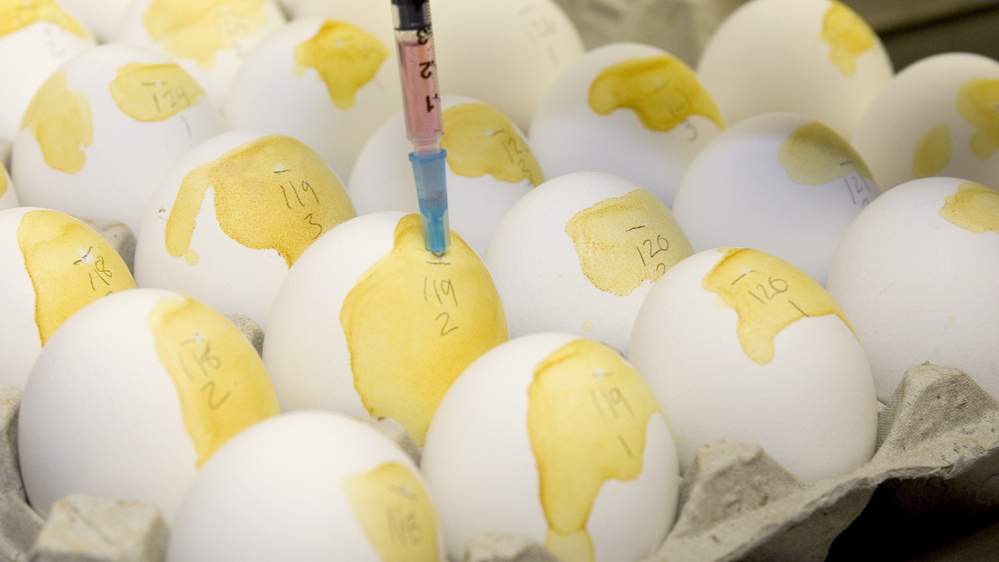
Researchers at the U.S. Geological Survey National Wildlife Health Center in Madison, Wis., use eggs to see if the Asian strain of the H5N1 bird flu virus has entered the U.S. in this photo from 2006.

Andy Manis/AP Researchers at the U.S. Geological Survey National Wildlife Health Center in Madison, Wis., use eggs to see if the Asian strain of the H5N1 bird flu virus has entered the U.S. in this photo from 2006. Researchers at the U.S. Geological Survey National Wildlife Health Center in Madison, Wis., use eggs to see if the Asian strain of the H5N1 bird flu virus has entered the U.S. in this photo from 2006.

Andy Manis/AP

For scientists who study a dangerous form of bird flu, 2012 is ending as it began — with uncertainty about what the future holds for their research, but a hope that some contentious issues will soon be resolved.

Last January, dozens of flu experts around the world agreed to what was supposed to be a 60-day pause in controversial experiments on the H5N1 bird flu virus. But none of them resumed work as planned because all year long, the debate over the benefits and the risks just wasn't going away.

Virologist Ron Fouchier of Erasmus Medical Center in the Netherlands says he reluctantly went along with the moratorium, "but I've not been a great advocate of it because there is urgency in this type of research."

Fouchier gets funding from the National Institutes of Health to study H5N1, which is widespread in poultry in parts of Asia and the Middle East.

H5N1 rarely infects humans, but more than half of those known to have gotten sick with it have died. Scientists have long wanted to know if this bird flu could mutate in a way that could make the virus start spreading between people and cause a pandemic.

Why Charities Need To Consider Donors' Politics

As American make contributions to various charities at the end of the year, there is increasing evidence that politics is playing a role in their decisions. Research suggests that the way the charity presses certain ideological buttons predicts whether liberals or conservatives will pony up a donation.


View the original article here

Sunday, 30 December 2012

Despite Uneven Results, Alzheimer's Research Suggests A Path For Treatment

Brain scans using Amyvid dye to highlight beta-amyloid plaques in the brain. Clockwise from top left: a cognitively normal subject; an amyloid-positive patient with Alzheimer's disease; a patient with mild cognitive impairment who progressed to dementia during a study; and a patient with mild cognitive impairment.

Brain scans using Amyvid dye to highlight beta-amyloid plaques in the brain. Clockwise from top left: a cognitively normal subject; an amyloid-positive patient with Alzheimer's disease; a patient with mild cognitive impairment who progressed to dementia during a study; and a patient with mild cognitive impairment.

Slide courtesy of the journal Neurology

It's been a mixed year for Alzheimer's research. Some promising drugs failed to stop or even slow the disease. But researchers also found reasons to think that treatments can work if they just start sooner.

Scientists who study Alzheimer's say they aren't discouraged by the drug failures. "I actually think it was a phenomenal year for research," says Bill Rebeck, a brain scientist at Georgetown University.

Rebeck is optimistic because during the year, several very different lines of research all began to suggest a new way of thinking about Alzheimer's — that it has to be stopped before it damages the brain.

"Once you start to lose a lot of synapses, once you start to lose a lot of neurons, your brain can't recover from that," Rebeck says. "And so when we start with people who have symptoms of the disease, treating them turns out to be unsuccessful."

That explanation comes in part from studies that used a new research tool approved by the Food and Drug Administration in April. The tool is a drug called Amyvid that's injected into the bloodstream and travels to amyloid plaques in the brain. Those are the plaques associated with Alzheimer's.

The dye, also called florbetapir, lets researchers detect even tiny plaques using a positron emission tomography, or PET, scanner.

"In the PET scan you can see whether somebody has amyloid in their brain...before [they show] symptoms of the disease. I think that's huge," Rebeck says.

Researchers have already used the technique to show that amyloid begins to build up decades before people start having problems with memory or thinking. Rebeck says it should also provide a much quicker way to gauge whether a new Alzheimer's treatment is working.

Another advance this year was a study showing that the brain begins to function differently long before symptoms of Alzheimer's appear.

Lori Beason-Held of the National Institute on Aging presented the study at the Society for Neuroscience meeting. She says previous research had found brain changes among people in the early stages of Alzheimer's.

"Our study has gone back even further and discovered changes in the brain that occur up to 11 years before any symptoms occur in individuals who eventually become cognitively impaired," says Beason-Held. And the changes probably start even earlier, she says.

That might sound discouraging, but Rebeck doesn't see it that way. "What that says is there's an opportunity, there's a window when if we could stop that amyloid from accumulating, or start to clear it out of the brain, then you could prevent those symptoms from actually ever happening," he says.

Another study this year suggests a way to do that. Researchers in Iceland discovered that families with a rare gene mutation are much less likely to get Alzheimer's. The mutation appears to interrupt a key step in the formation of amyloid.

In order to form amyloid, the brain has to first cut up a larger molecule, explains Robert Vassar of Northwestern University. That step requires an enzyme called beta-secretase or BACE 1.

"BACE 1 is like a pair of molecular scissors, and what the mutation does is sort of interfere with the way the molecular scissors can cut. It sort of like, dulls the blades," Vassar says.

Just a few months ago researchers came up with a drug that does the same thing that the gene mutation does naturally, says Rebeck. This drug, though, may have to be administered before amyloid has begun to build up.

Michael Raffi, of the University of California, San Diego, says the new thinking about amyloid and Alzheimer's is a bit like the current approach to cholesterol and heart disease. Doctors don't wait until someone has a heart attack before putting them on drug that lowers cholesterol.

"Really the ideal situation is to have checked their cholesterol levels 15 years prior, and seen whether it was elevated, which would imply that they have an elevated risk of having the heart attack, and starting the medication then," Raffi says.

It's still not clear, though, whether amyloid is the new cholesterol. "It took a long time for us to make that connection between cholesterol and heart disease," says Rebeck. "That's been very successful. It's been very helpful in so many people's lives. We're just [at] earlier stages in studying Alzheimer's disease."


View the original article here

Birds Hang Around Mistletoe For More Than A Kiss

Researchers in Australia found that when they removed mistletoe from large sections of forests, vast numbers of birds left.

Researchers in Australia found that when they removed mistletoe from large sections of forests, vast numbers of birds left.

BSIP/UIG via Getty Images

For the Druids, mistletoe was sacred. For us, it's a cute ornament and maybe an excuse to steal a kiss. And of course it's a Christmas tradition.

But for a forest, mistletoe might be much more important. It's a parasite, shows up on tree branches and looks like an out-of-place evergreen bush hanging in the air.

Its seeds drill through bark with a threadlike probe and then grow by sapping the energy of its host. And certain types can be nasty pests, especially dwarf mistletoe in the American West.

But it may actually be useful, and more than just as an excuse to make out with someone.

David Watson, an ecologist at Charles Sturt University in Australia, had long suspected this. But nobody had really proved it experimentally. So he did an experiment in an Australian forest.

He just took the mistletoe out.

"Me and a team of 12 volunteers in cherry pickers" — he recalls — "we removed just over 41 tons of mistletoe."

It took five months and then another visit the next season to get it all out.

Three Years Later ...

"The simple act of removing mistletoe led to losses of over a third of the woodland dependent species [of bird]," Watson says. All these birds just left. And weirdly, the birds that took the biggest hit were insect-eating birds.

"Especially the ones that eat insects on the forest floor," Watson says.

What do insects have to do with mistletoe? "It's a byproduct of how parasitic plants do their parasitizing," explains Watson. Parasitic plants are packed with nutrients that they gobble up from their hosts. They suck up all these salts and minerals to create a water gradient between them and their host so they can draw water out of their hosts.

"Parasitic plants the world over have 15 [to] 20 times more concentrated nutrients than their hosts," Watson says.

And because they're moochers, they don't really care about conserving their resources — they can just suck out more. Not so with regular trees, which pull out the good stuff from their leaves before allowing them to fall. But mistletoes just drop their leaves with all the vitamins inside.

"So there is this rain of enriched litter — a bit like mulch, a fertile mulch," as Watson puts it, that falls onto the forest floor under infected trees.

More goodies on the soil, more bugs, more birds that eat the bugs — it might mean more lizards and more mammals too, says Watson. Because of the apparently significant and widespread effects of mistletoe on a forest, he calls it a "keystone resource." He published earlier this year in the Proceedings of the Royal Society B: Biological Sciences.

Brian Geils, a retired forest pathologist for the U.S. Forest Service, says the jury is still out. As to whether mistletoe in the United States improves forest biodiversity in the way that it appears to in Australia, dwarf mistletoe in the Western U.S. doesn't have the same amount of leaf litter. And that particular type of mistletoe can kill trees. So he's hesitant to credit the parasitic plants with a blanket mantle of positive effects.

"It's quite complex to come up with a simple good or bad, more or less," Gelis says

Even so, he does agree that mistletoe has, for its size, a lot of bang for its buck in a forest ecosystem. For example, he says, it can cause some conifers to grow into what are known as "brooms" — strange-looking, twiggy, bushy poles that can act as ladders for fire and that attract a population of insects not normally found in the canopy.

Daniel Nickrent, a professor of plant biology at Southern Illinois University, is convinced mistletoes do have a similar role in North American forests as they do in Australian ones, particularly the phoradendron mistletoe found in the Eastern U.S.

"So does this keystone idea apply to some of the North Americans ones? I think they do," Nickrent says. "There's evidence they do."

Endangered snowy owls, for example, prefer to nest even in the pathogenic dwarf mistletoe. And, Nickrent says, some mistletoes appear to expand the fungal community that lives in soil beneath infected trees. The biggest instances of tree death by mistletoe aren't in natural forests but rather in human-created groves for lumber.

"This is like a beautiful petri dish that's not inoculated yet," he says of the large tree plantations that can be so afflicted by dwarf mistletoe. They're "just waiting for the mistletoes to come in and feed on this. So the human-altered ecosystems are heavily damaged by dwarf mistletoes."

However you look at mistletoe — keystone font of diversity or pathogenic parasite — being under one is a big deal, and not just for people.


View the original article here

Thursday, 27 December 2012

Stem Cells Treat Lou Gehrig's Disease, In Mice

Reporting in Science Translational Medicine, researchers write that neural stem cell implants were able to slow the onset of amyotrophic lateral sclerosis (ALS), or Lou Gehrig's disease, in mice. Study author Evan Snyder discusses the stem cells' protective effect, and why human trials may not be far behind.


View the original article here

Friday, 21 December 2012

Why Some Kids Have An Inflated Sense Of Their Science Skills

If you're a student at the halfway point of the academic year, and you've just taken stock of your performance, perhaps you have reason to feel proud of yourself.

But a recent study suggests some of the pride you feel at having done well — especially in science — may be unfounded. Or at least your sense of your performance may not be a very accurate picture of how good you actually are.

A massive analysis of some 350,000 students at nearly 14,000 schools in 53 countries has uncovered a paradox: Students in many countries that are mediocre at science have an inflated sense of good they are.

First the good news: The United States isn't among the worst offenders. Students in countries such as Thailand, Jordan, Mexico and Brazil seem to be worse than U.S. students when it comes to science knowledge, but they have even higher levels of self-esteem when it comes to their beliefs about how good they are at science.

But compared to countries such as New Zealand, Australia, Sweden, Japan, South Korea and Great Britain, American students appeared to have an inflated sense of their science abilities. Students in those other countries were better when it came to scientific knowledge than American students, but it was the Americans who had the higher opinion of themselves as students of science.

The study, published in the Journal of Cross-Cultural Psychology, focused on the academic performance of 15 year-old students. It was conducted by Eva Van de gaer, Aletta Grisay, Wolfram Schulz and Eveline Gebhardt.

The paradox between performance and students' impression of their performance has been noted before. The paper proposes an explanation for it: The reference group effect.

The study argues that countries have very different standards when it comes to science education.

In countries with elite science education standards, you can be a very good science student but, since you measure yourself against an elite standard of performance, you think of yourself as mediocre. On the other hand, if you live in a country with average (or mediocre) science standards, you might be just a decent student, but compared to general expectations of how good students are supposed to be, you feel like a genius.

In an interview, Schulz offered me an analogy. He asked me to think about a person who was 5-foot-10 in China and a person who was the same height in the Netherlands. The Dutch, on average, are taller than the Chinese.

"The person would in China probably think of themselves as a tall person," Schulz said. "If you go to the Netherlands, such a person would rather say, 'ah, I'm a short person,' because you compare yourself to those who surround you."

The same thing happens with science education, he said. Students in countries with elite science standards are much more likely to think of themselves as mediocre, whereas students in countries with mediocre standards are much more likely to think of themselves as elite.

Schulz works at the Australian Council for Educational Research, which studies educational issues in science, mathematics and reading.

Schulz told me the reference group effect could potentially be a double-edged sword: In terms of preparing students for competition with one another, it makes good sense to get a realistic sense of how good you actually are compared to, say, your peers in South Korea. On the other hand, Schulz said, there was also something to be said for having an inflated sense of your own abilities.

"For motivating students to take up science studies, how you perceive yourself is actually more important than how much you know," he said. "If your general belief (is) you're not that good at science, that might have this powerful effect of saying, 'Ah, I'd better stay away from it in the future.' "


View the original article here

Could Life Exist on Newfound Alien Planet?

In a paper to be published in Astronomy & Astrophysics, researchers identified five possible planets around the star Tau Ceti. One of these alien worlds is within the star's habitable zone. Study co-author Steven Vogt discusses whether life could exist on the planet.


View the original article here

Future Fibers May Be Spun From Slime

The hagfish or "slime eel" shoots out slime containing silk-like fibers of remarkable strength. Douglas Fudge, a biologist at the University of Guelph, says it could be a good substitute for today's synthetic fibers—it's 10 times stronger than nylon, for example—and bacteria can be trained to make it.


View the original article here

In Calif. Gold Country, A Rush That's Out Of This World

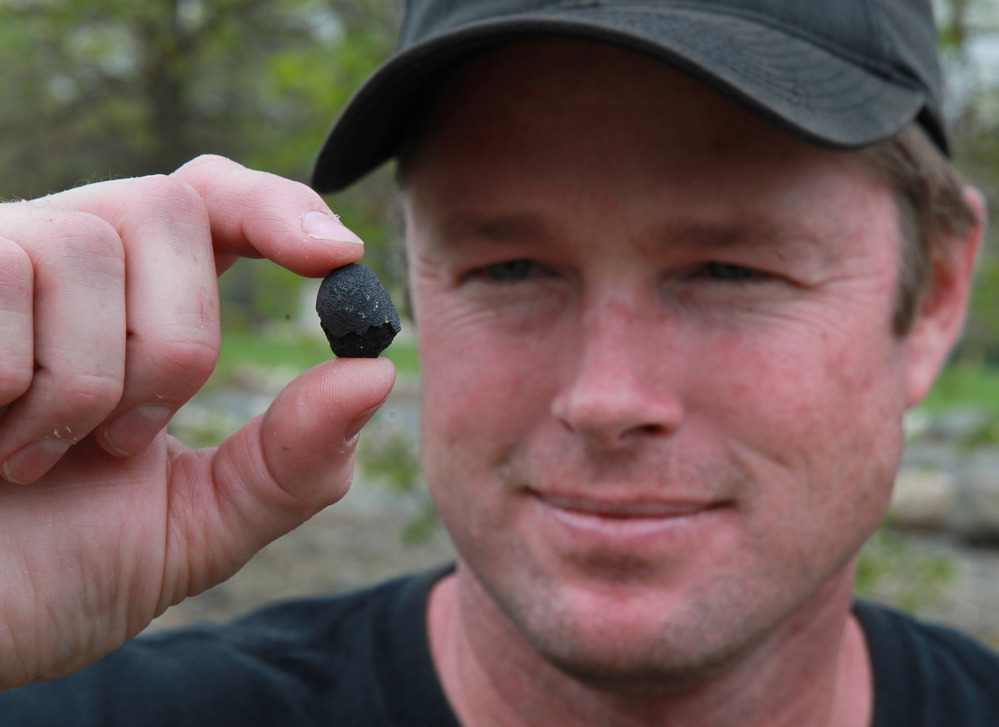
A section of the Sutter's Mill meteorite, dubbed "Darth Vader," is studied at a lab at the University of California, Davis. The meteorite is made of carbonaceous chondrite, which contains materials that formed the planets of the solar system.

UC Davis A section of the Sutter's Mill meteorite, dubbed "Darth Vader," is studied at a lab at the University of California, Davis. The meteorite is made of carbonaceous chondrite, which contains materials that formed the planets of the solar system.

UC Davis

On the crisp, clear morning of April 22, a 50-ton asteroid slammed into the Earth's atmosphere and shattered into countless pieces. Remarkably, they rained down onto Sutter's Mill, Calif., the exact spot where gold was discovered back in 1848, triggering the gold rush. And so follows a story of serendipity and scientific discovery.

"I was out on my hillside burning some branches and so forth, and I heard this sonic boom," says Gold Country resident Ed Allen. "It wasn't just one boom. It was a series of booms, literally right over my head."

He looked up to see if there was an airplane in distress.

"I did see a small trail of brown dust way up in the upper atmosphere," Allen says. "It was so unremarkable I didn't put the two together."

But within a day he was able to connect the dots. Reports of an impact were all over the local news. And, as his brother Norm explains, it didn't take long to pinpoint where the remnants had landed.

These words all apply to rocks from space, but each has a somewhat different meaning.

Asteroid — A chunk of rock traveling around in outer space, typically orbiting the sun in a zone of rubble called the "asteroid belt," which is between Mars and Jupiter.

Meteor — That's the flash of light you see in the sky when space rock hits the atmosphere. Usually meteors are generated by rock the size of sand or gravel.

Meteoroid — A generic term for a piece of rock, traveling through space. It can be a bit of an asteroid, or a chunk of a comet.

Meteorite — That's the rock you pick up off the ground (if you're really lucky) after a meteoroid lands.

"Apparently the weather radar actually picked it up coming down," Norm Allen says.

And that impact zone just happened to include the Marshall Gold Discovery State Park, where Ed and Norm Allen are volunteer docents. That's the site of Sutter's Mill, where the California gold rush all began. Within days, another rush was on — in a state park that happens to allow visitors to pocket any interesting rocks they might find, gold or otherwise.

"There were professional and semi-professional meteorite hunters out here, as well as just mom and pop with the kids," says Norm Allen. "In fact, one lady was pushing a baby carriage and found one of the bigger pieces that was found, right off the bat."

The biggest chunk was about the size of a fist. And soon professional scientists were on their way.

"It became quickly clear that this was a rather exceptional asteroid impact," says Peter Jenniskens, from the SETI Institute (SETI being the Search for Extraterrestrial Intelligence).

Jenniskens led the scientific search. First, he instigated the search of weather radar data to pinpoint the landing site. He also collected photographs and video from a few bystanders in the High Sierra. From those his team was able to conclude that the object was apparently a chunk of asteroid, probably weighing 100,000 pounds when it hit the atmosphere, and traveling at a blistering speed — 18 miles a second.

"Because it came in so fast, very little survived," Jenniskens says. "But because it was so big, we still got to find something."

Robert Ward found a piece of the meteorite at a park in Lotus, Calif., on April 25. The 100,000-pound meteorite was blown apart into small pieces as it met the Earth's atmosphere.

Rich Pedroncelli/AP Robert Ward found a piece of the meteorite at a park in Lotus, Calif., on April 25. The 100,000-pound meteorite was blown apart into small pieces as it met the Earth's atmosphere. Robert Ward found a piece of the meteorite at a park in Lotus, Calif., on April 25. The 100,000-pound meteorite was blown apart into small pieces as it met the Earth's atmosphere.

Rich Pedroncelli/AP

He hopped into his car and drove up to the park. On his first day of prospecting, he'd been off beating the bushes for hours near Sutter's Mill without luck. He'd given up for the day.

"I'm standing there, waiting for my friend to open the car, a little impatient. Then just a few meters from the car, I see little black rocks on the pavement. And I'm thinking, 'It can't be, can it?' "

But it was — small bits of this unusual space rock. And it was different from the usual meteorites, which look like Earth rock.

"Most meteorite falls we're getting on the Earth are from the terrestrial kind of stuff. Chunks of rock," Jenniskens says. "This is more interesting. This is the type of meteorite that carries organics with it to the Earth, that must have brought in the carbon that you and I are made out of."

It's called a carbonaceous chondrite, which is lighter and more porous than typical meteorites. That means the mineral is very susceptible to water damage once it hits the ground. Scientists were fortunate to have collected chunks so quickly.

"We actually got to see this type of meteorite in a pristine condition, sort of what you would get if you would go to an asteroid in space and you would collect a sample from this type of asteroid," Jenniskens says.

People ultimately collected about two pounds of the Sutter's Mill meteorite. And more than 50 scientists joined up as a consortium to study the rare space rock. Their first report appears in Science magazine.


View the original article here

Thursday, 20 December 2012

Scientists Look For New Drugs In Skin Of Russian Frog

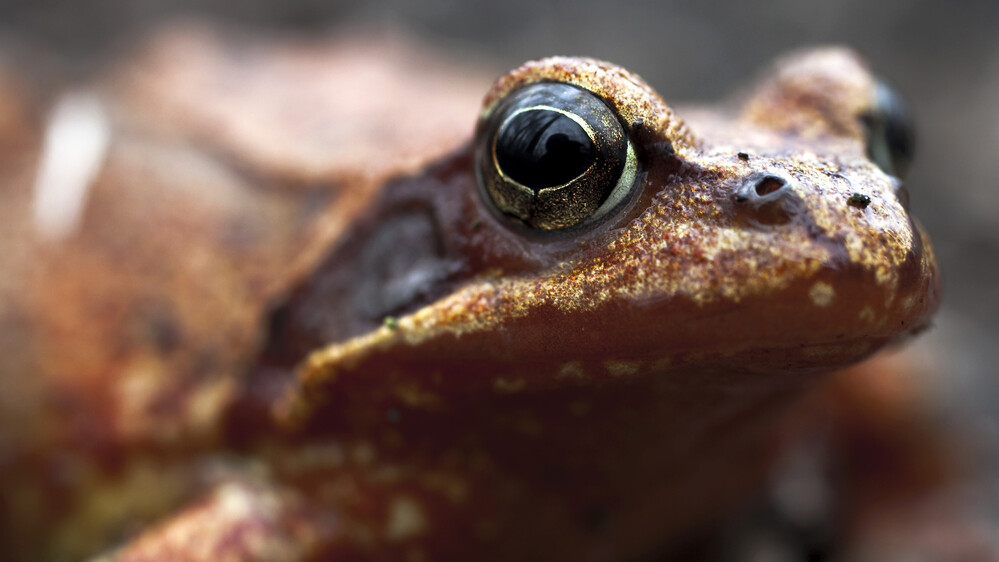
For centuries, Russians believed putting a brown frog in their milk would keep it fresh. Now scientists are finding chemicals in the frog's slimy goo that inhibit the growth of bacteria and fungi.

Stefan Arendt/Corbis For centuries, Russians believed putting a brown frog in their milk would keep it fresh. Now scientists are finding chemicals in the frog's slimy goo that inhibit the growth of bacteria and fungi. For centuries, Russians believed putting a brown frog in their milk would keep it fresh. Now scientists are finding chemicals in the frog's slimy goo that inhibit the growth of bacteria and fungi.

Stefan Arendt/Corbis

Before the advent of refrigeration, Russians had a neat trick for keeping their milk from spoiling. They'd drop a live frog in the milk bucket.

The Russians weren't sure how this amphibian dairy treatment worked, but they were convinced it did.

Since then, researchers have discovered that the goo some frogs secrete through their skin has antibacterial and antifungal properties.

One group of scientists led by a Russian chemist is trying to break down this frog goo at a molecular level. The researchers have found compounds they hope will lead to new medicines.

"Their activity is really enormous," says Albert Lebedev, a scientist at Moscow State University, describing the chemicals they've found in the goo.

Frogs have neither teeth nor claws, so the secretions from their skin constitute one of their main defenses against predators large and microscopic, Lebedev tells Shots.

To extract the secretions, Lebedev's team applied electrodes to the skin glands of Russian brown frogs. "It's not harmful," Lebedev says. "A little bit painful for her, but not harmful."

They analyzed the resulting milky frog goo and found a complex cocktail containing chunks of proteins called peptides.

Lebedev's team identified 76 different types of peptides that showed a variety of different properties that could be useful to medical science.

Now that scientists have identified some of the compounds present on the skin of Russian frogs, one of the next steps is to figure out how to create them synthetically. Lebedev says he's spoken with several pharmaceutical companies, including Pfizer, about doing this but his talks haven't led to any firm plans.

Natural substances do sometimes form the basis for synthetic pharmaceuticals, as our very own Adam Cole told us earlier today. But the process is a long and perilous one that leads to disappointment more often that it leads to a new drug, says Jun O. Liu, a professor of pharmacology at the Johns Hopkins University School of Medicine.

"There are natural substances that work in a lab beautifully but then when you give it to a human it's totally inactive or it's toxic," Liu says.

It's certainly possible that new classes of antibiotics or other drugs could be derived from chemicals in frogs' skin. But, Liu says, if that happens, it will be a long, long time before those drugs wind up in the pharmacy.

To read more about what Lebedev and his team found in frogs, check out their paper in the latest issue of the Journal of Proteome Research.


View the original article here

Unlocking A Frozen Lake's Bacterial Secrets

What does life truly need to survive? Writing in the Proceedings of the National Academy of Sciences, Alison Murray and colleagues describe a community of unusual bacteria that survive under 20 meters of ice in the dark, salty, sub-freezing waters of Lake Vida, Antarctica.

Copyright © 2012 National Public Radio. For personal, noncommercial use only. See Terms of Use. For other uses, prior permission required.

IRA FLATOW, HOST:

This is SCIENCE FRIDAY. I'm Ira Flatow.

FLORA LICHTMAN, BYLINE: And I'm Flora Lichtman. Up first, a new contender for biggest extremophile.

FLATOW: Extremophile, hmm.

LICHTMAN: Yeah, I don't know if that's a word.

(LAUGHTER)

FLATOW: Thirty years ago, when I visited - talk about extreme, I visited Antarctica, researchers were - actually I didn't go in there with them, but they were diving below the ice of one of the lakes there, it might have been Lake Vanda, I know I visited it, it's been a long time ago, to study the life under the ice, and that was really fascinating.

And it looks like they've continued to do that for at least three decades because this week, researchers described a community of bacteria that make their living frozen inside an Antarctic lake. It's super-salty, there's no sunlight. It's about negative 13 degrees Celsius, talk about extremophile, and their home is sealed off from the rest of the world for, oh, about 3,000 years.

LICHTMAN: That's so lonely. So what's life like for these Antarctic bacteria, and what can they tell us about the search for life on other planets? Joining us now to talk about that is Allison Murray. She's the co-author of a recent paper in the Proceedings of the National Academy of Sciences describing the research and an associate research professor in the Division of Earth and Ecosystem Sciences at the Desert Research Institute in Reno, Nevada. She joins us by phone. Welcome to the show.

ALLISON MURRAY: Hello.

LICHTMAN: Tell us what this environment is like where these guys were found.

MURRAY: Yeah, so the system is - the lake, as you said, is basically frozen, but at about 16 meters or 50 feet down under the ice surface, there is a matrix of brine that permeates through the ice, down to at least a depth of about 27 meters or 90 feet. And this brine is - the environment is dark. There's no solar energy getting down there. It's very stable. It's cold. The temperature is about minus 13.4, that's eight degrees Fahrenheit.

And it's able to stay liquid because of the high amounts of solutes in the brine, which keep it from freezing at that temperature. The geochemistry we characterized is very interesting and complex and is a very rich matrix of both salts, it's about six times as salty as seawater, has high concentrations of organic carbon and high gas concentrations of gases such as nitrous oxide and hydrogen.

LICHTMAN: So this is in the McMurdo Dry Valleys in Antarctica. And are the bacteria in these little salty rivulets in the ice, in these little channels?

MURRAY: Yeah, that's our best understanding right now is that the bacteria, that the brine is in fissures and in channels in the lake ice, and that is a pretty stable system, though probably dynamic to some degree, and under the lake ice cover.

LICHTMAN: What are they eating?

MURRAY: They are eating - this is a good question and a big part of our study. When we - we can tell that they are at least surviving, and they have low levels of metabolism, of protein biosynthesis. We think that they're eating probably a combination of the resources of the system. It's really quite energy-rich. There's a lot of carbon there. There are a lot of both oxidants and (unintelligible) in the system to provide energy.

There is no oxygen there, but there are a lot of other good substitutes for microbial metabolism. We think that they are probably eating and living off some of the resources that were buried in that ecosystem, the organic carbon resources that have been internally cycled since the system was isolated.

It's possible that they are also being fueled by some resources that are produced abiotically in the system, such as the molecular hydrogen that we detected, which we think is being produced by abiotic reactions between the brine and underlying sediments, some of which are - we encountered in the lower levels of the lake ice.

LICHTMAN: If they're sealed off, though, are they going to run out of food eventually?

MURRAY: Well, presumably that would be what we would think. We did some different types of back-of-the-envelope calculations to see what we could predict, and in some ways we would have predicted that the system would have already run out of energy.

The temperature is very limiting, though, here. At minus 13 and below degrees Celsius, we really don't know very much about the energetics of life at that level, and it looks like these cells are really more in a survival metabolism, maintenance metabolism than really growing and reproducing actively.

LICHTMAN: Give us the nitty-gritty on what these bacteria are. We love microbes, can't give us too much information on what they actually are. Do we - do they live in places that aren't as extreme?

MURRAY: Yeah, yeah, good question. So we characterized them in terms of their diversity based on the ribosomal RNA gene, and we can tell that they have organisms that fall into eight different phyla of bacteria. These - and we had detected at least 32 different species, and I'm sure that there's more the deeper that we look.

And the organisms are diverse in their physiological capability, if we compare them to cultivate representatives that have been isolated from other environments, mostly cold and salty environments in the Arctic and in Antarctica are kind of their nearest relatives in a lot of cases.

And they have a variety of metabolisms. So it looks like they're not all growing and making their living on way, that it's really kind of a diversity of ways that they could probably make a living in the system.

FLATOW: You know, this says to me, from the line in "Jurassic Park," life will find a way no matter what you throw at it. I mean, this kind of environment, and the bacteria live in there.

LICHTMAN: Yeah, I mean, are there places on Earth that are sterile?

MURRAY: Well, that's a good question. There are - you know, astrobiologists have been working in different environments, I think, and there is that question of whether there are places that are sterile, places where we thought, where there is no water has driven a lot of those questions. And so places like the Atacama Desert, where it rains, has in some places not on history.

But I think that - but even there they find that there are microbes in the soil crust. And good questions come from looking for life in the sub-glacial lakes of Antarctica and in Lake Vostok. And this year there's two other drilling projects that are going into different systems.

And so I think that for these really longtime isolated systems, it'll be really interesting to see what the results are there.

FLATOW: Well, thank you very much.

LICHTMAN: Thanks for joining us. Allison Murray is an associate research professor in the Division of Earth and Ecosystem Sciences at the Desert Research Institute in Reno, Nevada.

FLATOW: One more question before you go: Do you think there - this talks about how you might find life in other planets, perhaps, you know, the rings of - the moons of Jupiter, places where you don't - you know, it's pretty cold and frozen?

MURRAY: Yeah, I think that finding a system like this, it really is a new type of environment that we found here, and it's really expanded our vision of what is habitable and that if we look for some of the icy moons, right, of either Saturn or of Jupiter that this system may be one of the best analogs that we have right now on Earth for other systems like that, where we know that there are - there is ice and potentially similar habitats.

FLATOW: Sorry to interrupt, Flora. I had to get that...

(LAUGHTER)

LICHTMAN: No, I'm glad you got that question in there. It will recur later in the show. So good thing we covered it.

MURRAY: Right.

LICHTMAN: Thanks for joining us today, Allison.

MURRAY: OK, thank you very much.

LICHTMAN: Allison Murray is an associate research professor in the Division of Earth and Ecosystem Sciences at the Desert Research Institute.

Copyright © 2012 National Public Radio. All rights reserved. No quotes from the materials contained herein may be used in any media without attribution to National Public Radio. This transcript is provided for personal, noncommercial use only, pursuant to our Terms of Use. Any other use requires NPR's prior permission. Visit our permissions page for further information.

NPR transcripts are created on a rush deadline by a contractor for NPR, and accuracy and availability may vary. This text may not be in its final form and may be updated or revised in the future. Please be aware that the authoritative record of NPR's programming is the audio.


View the original article here
The Paradox And Mystery Of Our Taste For Salt

Bali sea salt and a spoonful of Hawaiian red alae salt.

Jim Noelker/AP Bali sea salt and a spoonful of Hawaiian red alae salt. Bali sea salt and a spoonful of Hawaiian red alae salt.

Jim Noelker/AP

Salt is one of those dangerously tasty substances. We add the magical crystals of sodium chloride to almost everything that we cook or bake, and according to many public health experts, we add too much.

They want us to cut back, to lower our risk of heart attacks or strokes.

Yet when you really start looking for ways to do this, you run into a paradox and a scientific puzzle.

First, the paradox. Too much salt may kill us, but our bodies need some of it to survive.

"If you don't keep up your sodium level in your body, you will die," explains Paul Breslin, a researcher at the Monell Center, a research institute in downtown Philadelphia devoted to the senses of taste and smell. (Breslin also teaches at Rutgers University.)

At the same time, Breslin continues, "there's no question that people who have high salt intakes are at risk for a heart attack and stroke and death, and that lowering their salt intake will save lives. In Finland, when they lowered the salt intake, stroke and heart attack rates went way down, and mortality went way down."

There are skeptics who discount the relevance of the Finnish example. The average person in Finland, at that time, was eating a lot more salt than Americans typically do. The anti-salt campaign brought that level down to around the global average. The skeptics say, for most of us, that average level of salt consumption may be just fine.

But both the World Health Organization and the U.S. Centers for Disease Control and Prevention are calling on people around the world to cut salt consumption even more. The average American, they say, should cut their intake of salt by a third.

This won't be easy, because people like salt. It makes many foods taste better.

This is where we get to salt's mystery. Scientists aren't exactly sure how much of our taste for salt is nature, and how much is nurture.

On the one hand, Breslin says, a massive international study of salt consumption around the world, conducted in the 1980s, suggests maybe we're born with it. "All across the planet, with a few exceptions, most people consume more or less the same amount of sodium," Breslin says.

The exception is people who can't easily get salt, such as isolated tribes in Amazonia. Everywhere else — from small villages in China to Chicago, people consume similar amounts — much more than our bodies need.

If humanity's taste for salt preference really is so universal, Breslin says, it's going to be really hard for any government to convince people to use less of it.

On the other hand, there's also some evidence that our preferences do shift, based on what's around us.

Gary Beauchamp, director of the Monell Center, says the first evidence for this came from stories told by doctors who ordered patients with high blood pressure to switch to a low-sodium diet. Their patients reported that "it was awful at first, but after a while, it wasn't so bad," Beauchamp says. Their taste sensors seemed to adapt, a little bit the way our eyes adapt to a dark room.

In fact, Beauchamp says, after they did that for a while, "when they went back to their normal food, it was too salty."

Beauchamp decided to carry out a more carefully monitored experiment to study this. He put people on a controlled, low-sodium diet, and they did adapt. "In about four to eight weeks, the amount of salt that they found optimal in soup or crackers declined by 40 or 50 percent."

It seems to show that we can get used to foods with less salt in it. So we could be healthier, and still enjoy our food just as much.

The problem is, there's no easy way to make this happen. Consumers aren't captives who can be forced to adapt.

Most of the salt that we eat comes via food that somebody else makes for us, such as bread, sandwich meat and salad dressing, and the companies that make those products aren't going to cut salt from them if they think it will drive consumers away.

"We'll always make sure these products taste good," says Todd Abraham, senior vice president for research and nutrition at Mondelez International, which makes Ritz crackers, Wheat Thins and Oreos. "If we produce products that are low-salt and consumers don't buy them, we haven't helped the American diet at all, because they'll go to a different product that has higher levels of salt."

A couple of years ago, a committee of scientists from the National Academy of Sciences' Institute of Medicine called on the government to help solve this problem with regulations.

Regulations, they pointed out, could force all the food companies to bring down salt levels in unison. There would be no high-salt alternatives, and consumers would eventually adapt to the new taste.

Food industry executives like Abraham don't like that idea. They say that such regulations are impractical. They also argue that regulations aren't necessary, because big food companies now are acting on their own. They are reducing salt levels, slowly and silently, in many processed foods. They're hoping that consumers won't even notice.


View the original article here

Counting Bugs In Panama? Get Out Your Tree Raft

Researchers collected almost 130,000 arthropods from more than 6,000 species from a section of forest in Panama over two years. It took another eight years for the insects to be classified. Here's a small sampling.

There are more species of insects than pretty much anything else in the world. And scientists know there are millions they haven't even identified yet. Now, in a tropical rainforest in Panama, a multinational team of scientists has just completed the first ever insect census.

Scott Miller, an entomologist at the Smithsonian who worked on the Panama, shows off one of the species from the survey that's at the National Museum of Natural History's insect zoo in Washington, D.C.

"We're standing in front of a colony of leafcutter ants," he says. "There you see one of the worker's who's carrying a leaf above its head and across its back as if it were sort of a sail, it looks sort of the like a sailboat, walking across the rock here."

Miller says the leafcutter ant is one of thousands of arthropod species in Panama's San Lorenzo forest. Arthropod are insects, plus spiders, mites, centipedes and pretty much everything else that lives on land and has at least six legs.

Many researchers thought that counting all the arthropods in even a small area of rainforest would be impossible. But that didn't stop Yves Basset, an entomologist with the Smithsonian Tropical Research Institute in Panama who led the study.

"We sampled every arthropod from the soil to the top of the forest — we call that the canopy," he says.

That canopy was as much as 13 stories above the forest floor. So Basset and his multinational team of researchers and volunteers had to get creative. They got help from professional tree climbers. They used a helium balloon to soar above the foliage. They had a helicopter lower a giant inflatable sampling platform onto the tree tops. And they also had construction crane right in the middle of the forest.

"You are — the scientist — actually sitting in a little gondola, a little, sort of cage, and then you have a radio and then you tell the operator where you want to go," Bassett says.

The floor of the rainforest is humid, but up in the canopy it's sunny, dry, and very windy.

"If you are sort of dangling on a rope when there is big wind, this could be dangerous," he says. "Also some branches might fall, so you have to be a bit careful about this."

Scientists used a variety of methods to collect arthropods in a section of Panamanian rainforest about the size of a football field.

It took Basset and his team two years to collect the specimens and send them out to labs all over the world for identification. The Smithsonian's Scott Miller says it took more than 100 scientists another eight years to process them all.

Miller says to identify the species, researchers relied in part on DNA analysis, and in part on the arthropods' physical characteristics.

"The hard parts of the male and female genitalia in many insects give us the diagnostic characters for species," Miller says.

In all, Basset and his colleagues had collected almost 130,000 arthropods — more than 6,000 species — from a total area of forest not much bigger than a football field. They published their results this week in the journal Science.

May Berenbaum, an insect ecologist at the University of Illinois at Urbana-Champaign, who wasn't involved in the Panama study, says nothing like this project has ever been done before. And it's important because of the critical role arthropods play in nature.

"They are what make communities run. They are the garbage disposers. They are the pollinators. They are the food for other organisms," she says.

And she says as development and climate change threaten places like tropical rainforests, we need all the baseline information we can get.

"If you don't know what's there, you don't know what's missing, and you don't know how to set aside, or how to save what you need to preserve the entire community," she says.

Berenbaum says she hopes there will be many more studies like this one.


View the original article here

Land Creatures Might Not Have Come From The Sea

The fossil remains of Dickinsonia, an Ediacaran organism that's long been extinct. Scientists have long assumed these early life forms lived in the sea, but a new study argues they emerged on land.

The fossil remains of Dickinsonia, an Ediacaran organism that's long been extinct. Scientists have long assumed these early life forms lived in the sea, but a new study argues they emerged on land.

G. Retallack/Nature

Cartoonists have found many clever ways to depict the conventional wisdom that complex life evolved in the sea and then crawled up onto land. But a provocative new study suggests that the procession might be drawn in the wrong direction. The earliest large life forms may have appeared on land long before the oceans filled with creatures that swam and crawled and burrowed in the mud.

This story is told from fossils that date from before an extraordinary period in Earth history, called the Cambrian explosion, about 530 million years ago. That's when complex life suddenly burst forth and filled the seas with a panoply of life forms.

Paleontologists have found fossil evidence for a scattering of fossil animals that predate that historic moment. These mysterious organisms are called Ediacarans.

Many scientists have assumed Ediacarans were predecessors of jellyfish, worms and other invertebrates. But Greg Retallack at the University of Oregon says he always had his doubts.

Retallack has been building the case that Ediacarans weren't in fact animals, but actually more like fungi or lichens. And if that idea weren't enough of a departure from standard theory, he now argues in a paper in the journal Nature that Ediacarans weren't even living in the sea, as everyone has assumed. He says he has reanalyzed some Australian rock where they're found and concluded that it's ancient soil, not marine mud.

These early life forms were landlubbers.

"What I'm saying for the Ediacaran is that the big [life] forms were on land and life was actually quite a bit simpler in the ocean," Retallack says.

So does that suggest life evolved on land and moved into the ocean?

"Yes, in a nutshell," he says.

This is an audacious idea. But Retallack is not alone in entertaining this possibility.

Paul Knauth at Arizona State University has been pondering this same possibility.

"I don't have any problem with early evolution being primarily on land," says Knauth, a professor in the School of Earth and Space Exploration at Arizona State University. "I think you can make a pretty good argument for that, and that it came into the sea later. It's kind of a radical idea, but the fact is we don't know."

Knauth says it could help explain why the Cambrian explosion appears to be so rapid. It's possible these many life forms gradually evolved on the land and then made a quick dash to the sea.

And, he adds, "that means that the Earth was not a barren land surface until about 500 million years ago, as a lot of people have speculated."

The new analysis of the Ediacaran fossils is at least a hint that this could be right. But of course if you're a scientist making an extraordinary claim, you need to back it up with extraordinary evidence.

"To me the evidence is not a slam-dunk," says Shuhai Xiao, at Virginia Tech.

He argues, among other things, that the same Ediacaran species found in what is arguably soil is also found in deposits that he says were ocean sediments.

That would imply that the same species would be able to live both on dry land and under a salty ocean. Xiao finds that unlikely. "It's pretty hard for the same species to be able to live in both environments."

So he is not convinced that Retallack is really looking at fossils in terrestrial soil. And so begins a sharp academic debate.

Xiao is far from alone in his skepticism. The current ideas have many defenders. Retallack seems to relish the controversy. He knows what he's in for.

"The idea that Ediacaran fossils were marine invertebrates is so deeply entrenched, it's in all the textbooks," he says. When someone (namely him) comes along and says that's not so, "it's going to be treated like a death in the family. It's going to go through all the phases of grief, starting with denial."

It remains to be seen whether the story ends with acceptance of Retallack's provocative proposal.


View the original article here

When It Comes To Boxed Wine, The Cooler, The Better

If you're picking a boxed wine for your party this season, be aware that temperature is everything.

AFP/Getty Images If you're picking a boxed wine for your party this season, be aware that temperature is everything. If you're picking a boxed wine for your party this season, be aware that temperature is everything.

AFP/Getty Images

Bag-in-the-box wine doesn't have the classiest of reputations. It's usually cheap and in the past at least, has been aimed at less sophisticated consumers. But in recent years, boxed wine has tried to buck the stereotype, whether by gussying up the product packaging or simply putting higher-quality wine in the box.

Still, if you're planning a holiday party and you want to try one of the new-fangled versions, don't think the fancy new packaging is going to protect your wine from going off any better than the old fashioned bottle, scientists say. In fact, it may be worse in some instances.

Temperature is a key factor in a wine's shelf life. "There's common knowledge in the wine industry that you shouldn't keep your wine in a warm place," says Helene Hopfer, a post-doctoral chemist and food sensory scientist at the University of California at Davis, especially if you plan to keep it around awhile. That's because the warmer the wine, the faster oxygen reacts with the compounds inside, which causes the wine to lose some of its aromatic compounds and turn a darker color. Basically, it becomes vinegar.

Hopfer and her colleagues wanted to see how different packaging strategies held up at different temperatures and recently published their results in the Journal of Agricultural and Food Chemistry. They put the same California Chardonnay in five different packages: natural cork, synthetic cork, screw cap, and two kinds of bag-in-box containers. For three months, they stored the wine at three different temperatures: 50 degrees Fahrenheit (10 C), 68 degrees Fahrenheit (20 C), and 104 degrees Fahrenheit (40 C).

They chemically analyzed the wine periodically, and a panel of tasters ultimately evaluated the wines' smells, tastes, and looks. At 68 degrees Fahrenheit, the bag-in-box wines showed small differences from the bottled wine, but at 104 degrees Fahrenheit, they aged significantly more quickly than bottled wine. (For what it's worth, the researchers didn't find a significant difference between real cork, fake cork, and screwtops.)

Temperature is something to think about when it comes to wine, says Hopfer. "You often get wines that are thermally damaged if you ship across the country, because there can be huge temperature differences during transport."

And while many of us would expect a vacuum-sealed bag to do a better job of keeping oxygen out than a breathable cork, it's not the case. The bag component of bag-in-box wines is made of a thin plastic polymer (polyethylene or polypropylene) that's actually pretty easy for oxygen to cross. Whereas "if you look at the glass bottle, the only way oxygen can get in is through the cork," says Hopfer.

Perhaps the more important finding is that at the colder temperature, boxed wine had basically aged the same as bottled wine. That's because companies have been layering different oxygen-stopping polymers over the initial breathable layer. "They've fine-tuned that bag for the wine industry," she says.

So, if you're stocking up wine for this season's holiday parties, boxed wine can meet your grape expectations. Hopfer advises: "The cooler, the better."


View the original article here

After A Year Of Study, Twin Probes Crash Into Moon

The GRAIL mission's gravity map of the moon. Very precise measurements between two lunar probes orbiting the moon allowed researchers to study the moon with great detail.

The GRAIL mission's gravity map of the moon. Very precise measurements between two lunar probes orbiting the moon allowed researchers to study the moon with great detail.

NASA/JPL/Caltech

At about 5:30 p.m. on Monday, two washing machine-sized space probes crashed into the surface of the moon. It was all by design and marked the end of NASA's GRAIL mission. The two probes had been orbiting the moon for almost a year, and they've sent back data that have given scientists an unprecedented look inside our nearest solar system neighbor.

The two little spacecraft had a big challenge: to map the interior of the moon from its crust down to its core. MIT geophysicist Maria Zuber says after more than 100 previous moon missions, scientists knew pretty much every nook and cranny of the lunar surface. "But the inside of the moon was still quite a mystery," she said.

Zuber, the lead scientist for NASA's GRAIL mission, which stands for Gravity Recovery and Interior Laboratory, says measuring the moon's gravity was the key to seeing what's inside it.

Here's how it works.

The two probes — they're called Ebb and Flow — fly in the same orbit around the moon, keeping as close as possible to its surface. One of the probes will fly over something massive, like a mountain.

That mountain "has a greater gravitational attraction associated with it," Zuber says, "so the first spacecraft speeds up and changes the distance between the two spacecraft."

By measuring those subtle changes in spacing between the two probes, Zuber and her colleagues could calculate the mountain's gravitational pull.

The gravity of underground structures tugged on the probes in the same way, so scientists could map what was below the surface too.

Bill McKinnon, a planetary scientist at Washington University in St. Louis, calls the mission a blazing success. "It's a tour de force," he says.

This animation from NASA shows the final path of the Ebb and Flow probes into the side of a mountain on the moon.

McKinnon wasn't involved in the lunar probe mission, but he calls GRAIL's scientific discoveries this year's greatest achievement in planetary science.

"People might say, well, what about the Mars lander, Curiosity? That was the engineering feat of the year," McKinnon said. But in terms of planetary science, McKinnon says nothing can top the GRAIL mission.

Jeff Andrews-Hanna, a planetary scientist at the Colorado School of Mines, analyzed some of the GRAIL data. He says some of what scientists saw inside the moon was unexpected. "We saw these big lines crisscrossing the surface of the moon that didn't show up in any other data set," Andrews-Hanna said.

Andrews-Hanna thinks those lines may be solidified, magma-filled cracks — the result of ancient volcanic eruptions. They're up to 300 miles long and tens of miles wide.

But Zuber says one of the biggest surprises was how bad of a beating the moon had taken early in its history. Scientists already knew the moon had been bombarded with asteroids and comets. But when they analyzed the new gravity map, "what we found is that the moon's upper crust was absolutely pulverized," Zuber said.

Zuber says this suggests that Earth and other planets would have gotten the same treatment. This ancient pummeling would have opened up deep cracks on Mars that might have drained away an early ocean. And on Earth, a fractured crust could have allowed gases to escape, helping to form an atmosphere.

Zuber says scientists are only at the very beginning of analyzing the data, so there's still a lot more to be discovered.

But for the probes Ebb and Flow, today marks the end of their mission. And Zuber is sad to see them go.

"It's really a bittersweet feeling for me, because these probes have been a part of our lives for the last several years," Zuber said.

Today NASA crashed the probes into a mountain near the moon's north pole. That part of the moon was in shadow, so the impact wasn't visible from Earth.


View the original article here

Buzz Off: Bedbugs Unfazed By Ultrasonic Devices

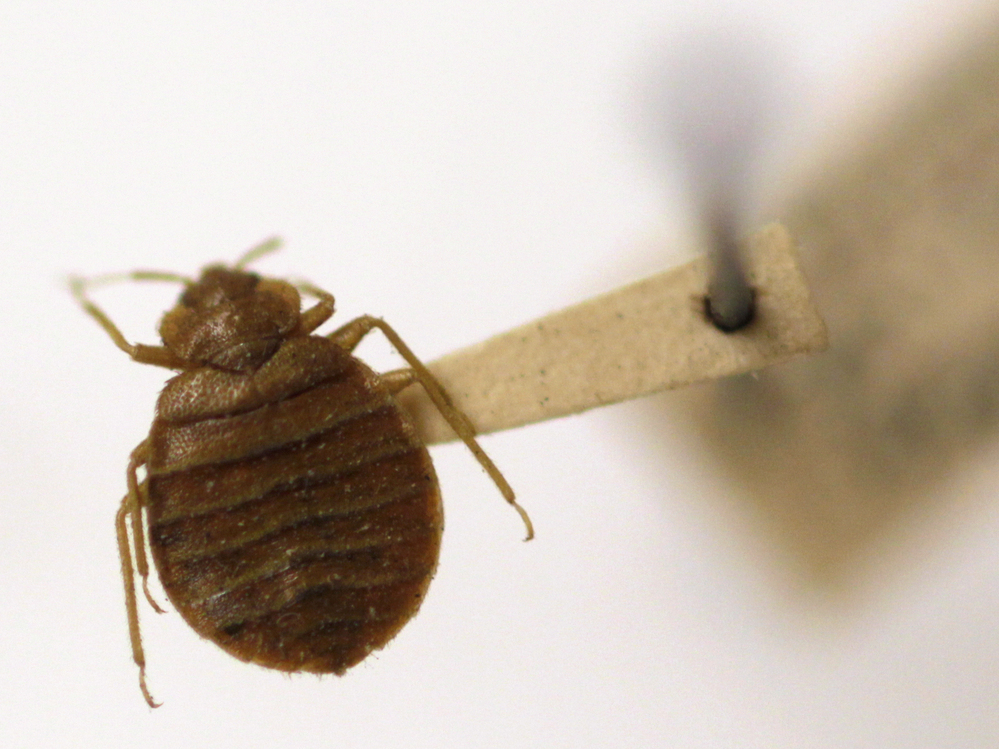
Bedbugs are becoming a common nuisance in many places. But cheap ultrasonic devices advertised as bedbug repellents don't work, scientists say.

Carolyn Kaster/AP Bedbugs are becoming a common nuisance in many places. But cheap ultrasonic devices advertised as bedbug repellents don't work, scientists say. Bedbugs are becoming a common nuisance in many places. But cheap ultrasonic devices advertised as bedbug repellents don't work, scientists say.

Carolyn Kaster/AP

With bedbugs bunking just about everywhere these days, people battling the bloodsucking insects may be tempted to try their hand at driving them away.

But ultrasonic bug zappers, which retail for less than $25, aren't the solution, say entomologists who tested some of the devices.

"I can understand on a personal level how you would want to go to great lengths and get rid of them and protect yourself," says Kasey Yturralde, a grad student in entomology at Northern Arizona University. She had a memorable trip back in 2006 when she ran into them while visiting a friend. "It was pretty traumatic," she tells Shots.

Recently, Yturralde and her co-author Richard W. Hofstetter tried out four different ultrasonic devices available on Amazon: one designed specifically for bedbugs and three that claimed to repel insects and small furry mammalian pests.

Their simple experimental design consisted of two 5-gallon buckets lined with sound-muffling insulation that were connected by a tube. An ultrasonic device was placed in one bucket, and eight to 10 bedbugs were placed in the tube.

More care was given to how the bedbugs were housed in the lab. The researchers kept them in large jars, like those used for canning, which were placed in bins full of soapy water. And every lip or edge over which an rogue bedbug would have to crawl was covered in a slippery substance a little like liquid Teflon, Yturralde says, to keep them from escaping.

In test after test, the bedbugs showed no preference for either bucket. "They were equally distributed across the two arenas," Yturralde notes. None of the four devices drove the bedbugs away.

It wasn't entirely illogical to think that ultrasonic frequencies might work against bedbugs. After all, the bark beetles Yturralde and Hofstetter normally study communicate in the ultrasonic range of sound. The devices could interfere with bug communication. But, of course, not all bugs act the same.

"There have been tests of these devices with other insects, and they haven't shown any effect," Yturralde says. Now people can know that they won't be effective on bedbugs either, she says, "and move onto other means of extermination."

The results appear in the Journal of Economic Entomology.


View the original article here

New York Planners Prep For A 'New Normal' Of Powerful Storms

A woman with the Army Corps of Engineers documents a destroyed home last month in a residential area of New Dorp Beach on Staten Island in New York City.

A woman with the Army Corps of Engineers documents a destroyed home last month in a residential area of New Dorp Beach on Staten Island in New York City.

Robert Nickelsberg/Getty Images

It will take tens of billions of dollars to repair the damage wrought by Superstorm Sandy. But scientists who study climate change say repair is not enough. As the climate warms, ice sheets and glaciers will melt, raising the sea level. That means coastal storms will more likely cause flooding.

So New Yorkers, local politicians and scientists face a tough decision: How to spend limited funds to defend themselves from what climate experts call "the new normal."

New York City faces the Atlantic Ocean like a chin waiting to be hit, and Sandy stepped up and whacked it. And there will be more storms like Sandy.

"Storms today are different," says Jane Lubchenco, who heads the National Oceanic and Atmospheric Administration, which includes the National Weather Service. "Because of sea level rise, the storm surge was much more intense, much higher than it would have been in a non-climate changed world."

Even garden-variety storms may someday heave water up to your doorstep. So the question now is: How to prepare for the next big one?

Some things are a given. You can see this as you drive through Staten Island's shore neighborhoods. Many of these houses are a coin toss above sea level. Sandy knocked one-story bungalows off their foundations and flooded the rest.

Repair crews go from house to house, cutting up soggy flooring and hauling away debris. Green and yellow stickers on the front doors tell a story: Yellow means the house isn't habitable; green means it's OK. Marit Larson, with the city's parks and recreation department, says most of the OK ones were built after the late 1990s, when building codes changed.

Who's Next? A boat displaced by Hurricane Sandy was dropped on Staten Island. Because of sea level rise, the storm surge was more intense than it would have been in a non-climate changed world, NOAA Administrator Jane Lubchenco says.

Christopher Joyce/NPR Who's Next? A boat displaced by Hurricane Sandy was dropped on Staten Island. Because of sea level rise, the storm surge was more intense than it would have been in a non-climate changed world, NOAA Administrator Jane Lubchenco says. Who's Next? A boat displaced by Hurricane Sandy was dropped on Staten Island. Because of sea level rise, the storm surge was more intense than it would have been in a non-climate changed world, NOAA Administrator Jane Lubchenco says.

Christopher Joyce/NPR

"Zoning codes required that no utilities were in the basement," she says. "Electrical and gas, heating — whatever utilities they had, had to be built on the second floor."

In between houses you can see wetlands — tall reeds and twisted trees in standing water. Larson says normally they slow runoff from rainstorms. But Sandy's 10-foot-high surge overwhelmed them.

"Just simply the amount of water that came in and inundated these people's property — that couldn't be held back by these wetlands," Larson says. She says wetlands could be useful for future storms, however, if you put them in the right place and make them big enough.

Along a beach, for example, wetlands help blunt the energy of incoming waves. But you need more. At this beachfront community, the beach is flat and narrow — not much help.

Sand Dunes And Sea Walls

Engineer Franco Montalto of Drexel University says it could be "nourished" — built up with sand or sediment to create dunes that hold back the water.

"And the evidence seems to be that places that had rehabilitated beaches suffered less damage than places that didn't," Montalto says.

For years, the Army Corps of Engineers has built sand dunes along East Coast beaches. Although many got swept away by Sandy, they're relatively cheap to rebuild. It's the kind of defense that Montalto calls "green infrastructure." He says the green strategy has multiple benefits.

"You know, a beach nourishment project could have value in terms of protecting houses, it could add habitat and could sort of enhance the value of this beach," Montalto says.

New York is seeking about $10 billion to prepare for the next big storm. Some experts, like Montalto, say you get more bang for your buck with a "distributed" defense — dunes, wetlands, bigger stormwater culverts, even urban parks that slow down the flow of water. They're cheaper and designed to fit the needs of a particular community.

But city officials are contemplating plans to build huge sea walls — across the mouths of the Hudson and East rivers, for example, and even one from New Jersey to New York. Each would cost $6 billion or more.

Klaus Jacob, a geoscientist at Columbia University's Lamont-Doherty laboratory in New York, is skeptical about sea walls.

"The only thing that barriers do is prevent storm surges," he says. "Now that's wonderful. It would have taken care of Sandy and will take care of future storm surges up to a point."

That point being when sea levels rise enough to push a storm surge over the top of the sea wall. Since no one knows how high levels will go, a sea wall could become obsolete in a few decades.

Moreover, a sea wall is open most of the time to let traffic through. So as the ocean rises, it will raise the river level, too.

"So now we have barriers. The sea level rise still goes wherever it wants to go," he says.

Jacob isn't against sea walls, but he says the city needs to figure out ways to live with higher sea levels and flooding, even if that means abandoning some flood zones.

Cynthia Rosenzweig, a climate scientist at NASA's Goddard Institute for Space Studies, says most New Yorkers have reached a tipping point on the subject of climate change.

"The evidence is indeed piling up that climate change is no longer something that is happening in future decades, and everyone's eyes are glazing over as the scientists are talking about it," she says.

Rosenzweig co-authored a report that looked at the costs and benefits of preparing the city for climate change. It calculated that $1 of prevention saves $4 in future repairs.

"If we're going to be having this much damage again and again, our whole economy of our region will not be able to survive," she says.

And as former New York Mayor Ed Koch once said, "New York City is where the future comes to rehearse."


View the original article here

Research Chimps Get Permanent Retirement Home

A previous version of this post mischaracterized the controversy over federally owned chimpanzees in 2010. The primates remained retired from medical research, but the National Institutes of Health drew criticism for planning to transfer them to a research facility from a reserve.

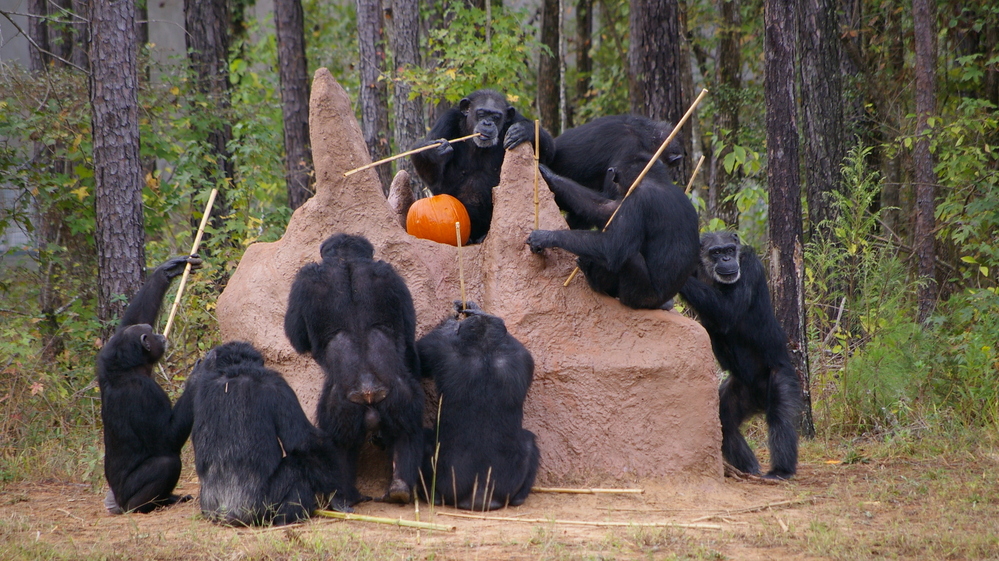
Chimpanzees check out a termite mound at the Chimp Haven sanctuary in Louisiana.

Chimp Haven Chimpanzees check out a termite mound at the Chimp Haven sanctuary in Louisiana. Chimpanzees check out a termite mound at the Chimp Haven sanctuary in Louisiana.

Chimp Haven

More than 100 chimps retired from medical research are about to get a new home.

Most of the primates who have been living at the New Iberia Research Center will soon make their permanent residence at the Chimp Haven sanctuary, the National Institutes of Health said Wednesday.

The federally owned primates have been the subject of controversy. In 2010, the NIH made arrangements to move some chimps from a research reserve to a research center, spurring protests from several animal-rights groups.

An independent report released last December said there was almost no scientific need for doing biomedical research on chimps. In September, the NIH accepted the report's recommendations and formally retired all chimps at the NIRC, despite some scientists' objections.

Initially, only 10 retired NIRC chimpanzees were expected to arrive at Chimp Haven. Though 10 new residents would have filled the Louisiana sanctuary to capacity, behaviorists were able to create some extra space by carefully rearranging the chimpanzees into new social groups.

"It's actually a very complex process. They have to evaluate their health status, their behavioral attributes, and then they determine how [the chimps] will act in various social groups," says Renate Myles, an NIH spokeswoman. "[The behaviorists] will say, 'Oh I think these chimpanzees will do nicely with these other chimpanzees,' then they try it. If it doesn't work, they have to start all over again," she tells Shots.

In addition to the space created by social reorganization, Chimp Haven will look to expand its facilities with new enclosures that are expected to cost about $2.3 million.

Congress authorized $30 million for the care of chimps retired from biomedical research in the Chimpanzee Health Improvement, Maintenance, and Protection Act in 2000. But the NIH is nearing this cumulative cap, and it can't pay for an expansion at the sanctuary.

The Humane Society of the United States and the Foundation for the National Institutes of Health (an independently funded nonprofit) have pledged to cover the cost of the new facilities.

"NIH has worked diligently to see that the federally owned chimps at New Iberia Research Center will be sent to a world-class sanctuary and the Humane Society of the United States is pleased to fund a portion of the construction costs," said Wayne Pacelle, president and CEO of the Humane Society, in a statement earlier today.

Though only 110 chimpanzees were retired from NIRC in September, 113 will be arriving at Chimp Haven in the next year or so. Eight of the original chimps gave birth to babies. One animal died, and four more were declared too old and frail to make the trip to the sanctuary, NIH's Kathy Hudson said in a media briefing.


View the original article here

Ask A Quantum Mechanic

Did you know plants use quantum mechanics every day? That quantum computers can hack the encryption used in online commerce? Or that a 'quantum internet' could someday teleport your emails? MIT's Seth Lloyd discusses those and other quantum mysteries in this episode of "Ask a quantum mechanic."

Copyright © 2012 National Public Radio. For personal, noncommercial use only. See Terms of Use. For other uses, prior permission required.

IRA FLATOW, HOST:

Speaking of upside-down, there is no more a topsy-turvy world, a mysterious place that's hard to believe than the quantum world. Now I'm going to warn you, it's a weird place where all our intuitions about how things should behave, they fall apart. For example, electrons can be here and there at the same time. Imagine if that happened with your eyeglasses, like in the last segment.

And when you're not looking at something, you can't be sure if it's there or not. If you do happen to turn your head to examine something, you might disturb it, and it may not appear as it was before. Sounds a little like "Alice in Wonderland," doesn't it?

Well, luckily we have a tour guide who's going to walk us through the scary stuff, answer your questions, too. Continuing our Ask an Expert series, it's Ask a Quantum Mechanic. And we have the perfect guy. His lab motto is: If your quanta are broke, we fix them. I wonder if they make crescent wrenches for quantum mechanics. We'll ask him. Seth Lloyd is professor of mechanical engineering at MIT in Cambridge. He joins us from WBUR.

And if you want to talk to Seth, our number is 1-800-989-8255, 1-800-989-TALK. You can also tweet us @scifri. You might be getting through and listening to us on the Internet today, and you can tweet us @scifri, S-C-I-F-R-I. Ask questions of a quantum mechanic. Welcome, Seth.

DR. SETH LLOYD: Hey, Ira.

FLATOW: How do you begin to, you know, explain to people what quantum mechanics is?

LLOYD: Yeah, well, quantum mechanics is the branch of science that deals with stuff when they're really small and also when they're really big because in fact quantum mechanics pervades the universe to the largest scales, as well. And I guess the way I would start is by saying that quantum mechanics is weird.

This is a technical term.

(LAUGHTER)

LLOYD: It means it's strange. It's like as James Brown said when asked what he was going to play next: I don't know, but it's got to be funky.

FLATOW: It's funky.

(LAUGHTER)

FLATOW: Funky is a nice way to describe the quantum world. Funky. And the famous line, I think that you know and we all know, that is the most famous line about quantum mechanics is the Richard Feynman line, right? About...

LLOYD: Which line would be...

FLATOW: Well, he has a lot of them but the one about if anybody who tells you why or how it works that we know it's true, but if they understand why it works, they say that, they're lying.

(LAUGHTER)

LLOYD: Yeah, that's right. Yeah, Niels Bohr also said anybody who thinks they can contemplate quantum mechanics without getting dizzy, like the upside-down eyeball man of the previous segment, well, they haven't understood it. Of course, he said it in Danish, which is more impressive.

(LAUGHTER)

FLATOW: Let me ask you then to begin with something that people have heard of all the time, but they may not quite understand it, and that is the Schrodinger's cat paradox. What is going on, and why is that even there?

LLOYD: Yeah, so in quantum mechanics, it's pretty common, in fact it's pretty much mandatory, for things to be in two places at the same time. So, something like an electron, which is, you know, a very quantum mechanical thing, can be both here and there simultaneously.

Well, you know, if you have an apparatus that takes electron over here and, you know, strokes your cat, and then the apparatus that the electron's over there, it strangles your cat, well then your cat is alive and dead at the same time.

I think when Schrodinger proposed this, I don't think the SPCA was as strong as it is now.

FLATOW: Yeah, he would never have gotten away with it. So what happens when you open the box?

LLOYD: Well, so if you open the box and look at it, you're either going to find the cat to be either alive or dead. But the funny thing comes about because it's possible to actually make a measurement in principle that would reveal the cat to be alive and dead at the same time. I was just - actually last week, I was at the University of Vienna, and I was in a kitchen, and Schrodinger's desk was in the kitchen.

And I have to say, I was very disappointed that it was only in the kitchen on the third floor and not in the kitchen on the second floor at the same time.

FLATOW: That's because you actually were looking at it at that point.

LLOYD: Yeah, yeah, that's right. (Unintelligible) cups of coffee.

FLATOW: Explain that whole idea about - I remember John Wheeler(ph), who, you know, was one of the famous - he used to talk famously about quantum mechanics. He had the idea that - and he tried to explain this to me 30 years ago, and I'm still trying to grasp it - that the act of looking at something then makes it happen.

LLOYD: Yeah, you can think of it that way. Of course, John was a wild and crazy man himself, and he used to draw this, for many of his talks, this picture of the universe like a big U with an eye on one part of it investigating the other half of the U, kind of crazed.

And so, what makes things be in one place or another is looking at it, but it doesn't have to be just looking at it. You can just have - you know, if another electron whizzes by and whacks off the electron over here, well then it's done what is called de-cohered the electron. So the first electron is now not here and there at the same time but in either here or there.

FLATOW: So then the act of observation, not just by you but even another electron coming off, I guess observation would be if you shine a light on it, you're shining a lot of electrons on it. That would be sealing its fate.

LLOYD: It's really de-coherent. Yeah, the famous physicist Eugene Wigner once claimed that it was only when consciousness perceived quantum things that they went from being here and there at once to being either here or there. But it doesn't take much consciousness. An electron is not a very conscious thing last time I checked.

FLATOW: Well, is there any evidence in the macro world that's not in the subatomic world? Can we see any evidence of it?

LLOYD: For sure, in fact this year's Nobel Prize in physics was given to Dave Wineland at the National Institutes of Standards and Technology and Serge Haroche at the École Normale Supérieure for demonstrating not Schrodinger's cats because of the things they were making dead and alive at the same time, but what they called Schrodinger's kittens.

So these are relatively macroscopic sets of particles, in their case particles of light, or photons, that are both here and there simultaneously. And I myself participated in a great experiment done by Casper Vandervole(ph) in which we took a superconducting loop and had a gajillion electrons going clockwise and counterclockwise simultaneously. A gajillion is, again, a technical term.

FLATOW: Yeah, and so what happened?

LLOYD: They went both ways at the same time. I mean, I don't know. We weren't looking at them, I'll tell you that much.

(LAUGHTER)

FLATOW: Both ways at the same - how do you know they're going both ways at the same time? If you can't look at it and observe it, right, which would ruin the experiment, how do you know they're both going in...

LLOYD: Yeah, so it depends on what question you asked them. So if you asked them are you going clockwise, or are you going counterclockwise, they're just going to show going clockwise or counterclockwise. But the guts of this experiment was to come up with a sneaky way of saying: Hey, are you going clockwise and counterclockwise at the same time? And they said: Yup, uh-huh, yes we are.

FLATOW: Yes, the old joke quantum-mechanically placed. 1-800-989-8255. Seth Lloyd is with us to talk about questions about quantum mechanics, if you want to ask him. You can also tweet us @scifri, @-S-C-I-F-R-I. And maybe we'll get into a little bit of Einstein and quantum science when we come back after the break. Stay with us.

(SOUNDBITE OF MUSIC)

FLATOW: I'm Ira Flatow. This is SCIENCE FRIDAY from NPR.

(SOUNDBITE OF MUSIC)

FLATOW: I'm Ira Flatow. This is SCIENCE FRIDAY from NPR.

(SOUNDBITE OF MUSIC)

FLATOW: You're listening to SCIENCE FRIDAY. I'm Ira Flatow. We're talking about quantum mechanics, everything you've ever wanted to know. And someone who knows everything we want to know is Seth Lloyd, he's our guide on quantum mechanics. And we asked some interesting questions. We posed a question on Reddit, asked people to ask questions on Reddit, and one interesting one, has always boggled my mind, and I've only been reading this for 40 years, so here it is:

It's often said that quantum entanglement, quantum entanglement is spooky action at a distance and instantaneous. However, it is impossible to transmit information faster than the speed of light. So, one, what is meant by instantaneous in this sense; and two, what is being transmitted between the entangled particles? I'm putting my feet up on this one, so...

(LAUGHTER)

LLOYD: Yeah, yeah, so quantum entanglement or spooky action at a distance, or as Einstein put it, (speaking in German), sounds cooler in German somehow...

FLATOW: Well, he had a Nobel Prize for it.

LLOYD: Yeah, actually, in fact, you know, Einstein got his Nobel Prize for his work on quantum mechanics, not in special relativity. And the funny thing about Einstein and quantum mechanics is he never believed it. He always, you know, he said basically, the problem is that quantum mechanics is very counterintuitive.

It's counterintuitive to me, it was counterintuitive to Einstein, the difference here being that Einstein deserved to trust his own intuition. So he did, and he said it's got to be wrong.

In my case, you know, my intuition is usually wrong. So if my intuition says hey, things can't be, you know, two places at the same time or have spooky action at a distance, I say what the heck, it could be true.

FLATOW: Well what is it? What is instantaneous? Why is it not violating this speed-of-light concept?

LLOYD: So entanglement comes from taking this notion of things being two places at the same time and having things in two places and in two different states at the same time. So you can have a state where, you know, photon over here is wiggling from left to right; it's horizontally polarized, correlated with photon over on this other place being horizontally polarized, as well, or they could both be vertically polarized.

But now the funny thing in entanglement is that they're both horizontally polarized and both vertically polarized at the same time. Now on the face of it, that doesn't sound so bad. But the problem is if you measure one photon, say the photon on the left, and you find it to be horizontally polarized, that means instantaneously the photon on the right has gone from being in some sense vertically polarized and horizontally polarized to being just horizontally polarized. So just wiggling back and forth rather than wiggling up and down.

And so, when our classical intuitions try to contemplate this state, or this funny phenomenon called entanglement, it seems to - our intuition is that information is being sent instantaneously from one place to another.

FLATOW: But you're saying it's not being sent.

LLOYD: That's right. So - well, there's a caveat here having to do with black holes and closed time-light curves. But we can get to that in a moment.

(LAUGHTER)

LLOYD: I know you like to talk about that stuff, Ira.

FLATOW: Stay tuned. No I do, but I still - you know, I still can't get past this - there's no information going between one to the other. So it doesn't violate the law, right?

LLOYD: Right. So if you actually try to send information, what you have to do is you have to do something over on Point A, which changes the probabilities of something happening at Point B. And the measuring over Point A, you have a 50-percent chance of finding the photon wiggling back and forth rather than up and down.

And before you measure the photon at Point B, it also has a 50-percent chance of being wiggling back and forth or up and down. Now afterwards when you measure, you know for sure, if you get the answer back and forth, that the other photon (technical difficulties) back and forth. But for an observer on the other side who makes a measurement, they don't know that it should be back and forth, so when they make a measurement for them, it's still 50-percent back and forth and 50-percent up and down. So you can't send information.

The problem is that for classical intuitions, it appears as if something is happening instantaneously, but quantum mechanically, nothing is happening instantaneously.

FLATOW: Thus Einstein called it spooky action at a distance, 'cause it makes your hair hurt.

LLOYD: Yeah, that's right.

(LAUGHTER)

LLOYD: Exactly or stand on end. If I had hair, I would have it stand on end.

FLATOW: I'm sorry, I didn't mean to bring that up.

(LAUGHTER)

LLOYD: Yeah, well, in another quantum world out there, I have a full, bushy head.

FLATOW: Are there - I mean, are there supposedly many, many quantum worlds out there, many quantum universes, or is that a different theory?

LLOYD: This is another strange and counterintuitive feature of quantum mechanics, which is related to entanglement. So in this case of the photons, or when I measure one, I - you know, before they're both up, both back and forth or both up and down at the same time, and when I measure, I only get one of these possibilities.

But if you look at what happens quantum mechanically, including a quantum description with me, what's happened quantum mechanically is the world has effectively split in two, and there's two me's, one of which got them going back and forth and the other one of which got them going up and down.

So this is a phenomenon that goes with the name of the many worlds theory, which says that every time I or you or anybody makes a quantum measurement, the world splits into different possibilities, in each one of which one of the possible things has happened.

FLATOW: Even though we can't understand it intuitively, it's widely accepted because we can test it out, and it works?

LLOYD: Well, the many worlds theory...

FLATOW: Would that be fair? I mean and all of quantum mechanics in general?

LLOYD: Oh all of quantum mechanics, yeah. So, well, you know, there are some folks like Einstein who never really accepted quantum mechanics, and there are even Nobel laureates alive today who think that quantum mechanics isn't the end, the be-all and the end-all. And that's just because they trust their intuitions, which says it's wrong.

The thing is that quantum mechanics is the - if you look at all of our physical theories, with the possible exception of natural selection, it has the most number of pieces of confirming evidence. You know, every time the Large Hadron Collider, you know, in the course of one second it collects trillions of bits of evidence that quantum mechanics is the case.

And nobody's ever collected a single piece of evidence that quantum mechanics is not the case. So from the kind of preponderance of evidence perspective, you've just got to suck it up.

FLATOW: Let's - that's a segue I'm not going to touch. Let's go to the phones, to Jerry(ph) in Columbia, South Carolina. Hi, Jerry.

JERRY: Hi Ira, how are you?

FLATOW: Fine, how are you?

JERRY: I - the question that I have for the guest is that from everything that I understand about quantum mechanics, fundamental particles that are so small we have those instances when we observe them, and that seems to affect them, we know that. But it seems like scientists are making an assumption. Basically, there are those moments when this particle is not being observed, and there are those moments when it is being observed.

What leads scientists to say OK, here's an electron that's just made contact with something, and now after that we're going to assume that it's still an electron and it's still behaving the way that it was behaving when we observed it?

Isn't it possible that subatomic particles are not the way that we think they are when we're not observing them?

LLOYD: Well Jerry, that's a very good question. So of course anything is possible, and lord knows we don't know everything about subatomic particles. Like, we don't know what the dark energy in the universe is, we don't know what the cold dark matter is. But from the quantum mechanical perspective, basically it says when you observe this particle, you kind of pin it down.

So the way in quantum mechanics this works is that every particle, like an electron, has a wave that's associated with it. And the wave - the electron is like a point-like particle. It's just in one place, you would think. But the wave tells us where it is. And the wave can be in many places at once.

And so when you pin down the electron, you also pin its wave down to a particular point. But as soon as you've pinned it down, once you stop looking anymore, that wave starts spreading out and rippling and going many places at once.

FLATOW: Can you describe it as there being an infinite number of possibilities in the quantum world, but when you then observe one of them, all the rest of them go away, and you were left with the one you're observing?

LLOYD: Yeah, I think that that's a very good way to describe this. And this actually tells us a nice way to think of this many worlds theory. So in the many worlds, there are all these different possibilities. There are - actually, interestingly, it's only a finite number of possibilities, not an infinite number. It's just a very large number of possibilities.

FLATOW: I failed that test.

(LAUGHTER)

LLOYD: That's OK. But so one way to think of this many worlds theory is that all of these realities exist simultaneously. But another way, Ira, is the way you just described it, to say when we make an observation, we just get one piece of this, and the other ones might be there in some funny quantum mechanical sense, but so far as we're concerned, they're not there because we, you know, they're basically the things that are not the case. You know, the electron, I measure the electron. I find it here.

FLATOW: Yeah.

LLOYD: The other part of the wave function, the electron is over there. To heck with that. I don't care about that other part of the wave function.

FLATOW: Yeah. Is there something about - possible about quantum biology?

LLOYD: This is a really interesting question. So, for many decades, most people thought, well, you know, in quantum mechanics, it's tough for things to have this two-places-at-once kind of thing going on if they're constantly being bombarded by the environment because it's these interactions with the environment that so-called decohere the quantum system and prevent things from being too places at once.

But remarkably, over the last five years, a whole bunch of experimental evidence has accumulated, starting with work from the Fleming Group in Berkeley, that in photosynthesis, for example, that as energy makes its way through photosynthetic complexes, after, you know, photosynthesis, light comes in, creates a particle of energy called an exciton. It's kind of a nice name for a...

FLATOW: Right.

LLOYD: ...particle of energy. That this exciton, as it's going through the photo complex to get turned eventually into chemical energy, that it's taking multiple paths at once. So the exciton really is in more than one place simultaneously. And moreover, this funky quantumness is what's responsible for the tremendous efficiency of energy transport in photosynthesis, which is upwards of 99 percent.

FLATOW: So it is actually working in a macro world, but we just don't see it in action.

LLOYD: Yeah. That's right. I mean, that's right. Every time - actually, every time we put on sunblock, we're responding to this because when we - our skins also absorb energy from light, and excitons are created. And the problem is that excitons can be bad and mess things up, so...

FLATOW: Yeah.

LLOYD: ...we're actually responding to quantum weirdness when we slather ourselves with white stuff.

FLATOW: Hmm. Speaking of weirdness, Dana(ph) is on the phone from Plymouth, Mass. Hi, Dana. Welcome to SCIENCE FRIDAY.

DANA: Hi. Thank you. Well, you kind of stole my thunder. You answered my question, actually, about Einstein and why he couldn't fully embrace quantum physics. So can I ask another question?

FLATOW: Sure. Sure.

LLOYD: Sure.

FLATOW: Free one today.

DANA: Can you please spell out Planck's constant? I read about it, and I kind of understand. I can't wrap my head around it. Maybe if I hear another, you know...

FLATOW: Yeah.

DANA: ...a different explanation. Yeah.

FLATOW: I know. You know, particle physics, you got to read it 40,000 times.

(LAUGHTER)

FLATOW: I get you. I get you. I'm with you on this, you know? How many books I have read on this stuff over and over? It's like reading it new the first time. Thanks a lot, Dana. We'll see if we can get - what is Planck's constant?

LLOYD: Yeah. So Planck's constant dates to the very first paper on quantum mechanics written by Max Planck in 1900. And he was concerned because when people did calculations of how much energy was being emitted in the light coming out of a hot stove, you know, when it's glowing red-hot or white-hot, that if you do the classical calculation of how much energy is coming out, the amount of energy should be infinite, which would be kind of a bummer. It meant, you know, you could really - you don't - you don't just want to get warmed by the stove. You want - don't want to get vaporized.

FLATOW: Yeah.

LLOYD: Actually, also the amount of information coming out of the stove is infinite, which is also bad from the computational perspective. So he said, hey, you know, how about we just see what happens if the energy doesn't come out in a continuous form, in the form of waves, as Maxwell's equation would suggest, but it comes out in a - bits of chunks, chunks of energy? So - or which are he called quanta. So, you know, this is kind of the chunk style version of energy.

FLATOW: Yeah.

LLOYD: And he said, let's suppose, just for the heck of it, that of a - that light with - that's - with some frequency F comes out within a chunk of energy, a quantum with energy some constant times F. And he came up with this constant, which since been called Planck's constant, which sets the chunkiness scale of nature. And by doing this, he was able to show - get exactly the right answer for the spectrum of energy coming out of hot bodies.

FLATOW: Interesting. Interesting. Jason(ph) write - tweeting me. He's begging me. He's begging me to talk about quantum computing and the quantum mechanics relation. What is the future of quantum computing? We'll get your answer after I remind everybody that I'm Ira Flatow. This is SCIENCE FRIDAY from NPR. Seth Lloyd, take it away.

LLOYD: Yes. OK. So, yeah. So quanta computing, which is - it's kind of what I do on a daily basis, you know, getting our hands and arms and legs and entire faces dirty, messing around with those quanta. You know, that's why our lab motto is that we're - if your quanta are broke, we'll fix them.

FLATOW: You need a quanta washing machine then.

LLOYD: So - that's right. Well, actually, you know, we haven't gotten to quantum teleportation, which allows you to vaporize the particle over here and then have it rematerialize over there, which we - if we could apply to human beings, we wouldn't have to talk about quanta computing. We could talk about quantum commuting.

FLATOW: Wow. They figured that out on "Star Trek" already, I think.

(LAUGHTER)

LLOYD: That's right. So quanta computers are computers. You know, have - they flip bits, like any other computer, but in quanta computers, the bits are - all exist at this quantum mechanical level, so, you know, a quantum bit could be an electron that's over here, an electron that's over there. We'll call electron over here zero and electron over there one. But quantum bit or qubit, which, by the way, I used to believe was the distance from my elbow to my extended finger. But a qubit and...

FLATOW: I got it. I got it. I got it.

LLOYD: Yeah. OK. The electron can...

FLATOW: Behind the eight ball. I get it.

LLOYD: Yeah. The electron can be both here and there simultaneously. This is a normal quantum mechanical thing. So the resulting qubit then, in some funky quantum sense that we can't intuit, registers zero and one simultaneously. And when you turn this into a whole computer doing this, then you're going to have a computer, a quantum computer that's doing multiple things at once.

So, you know, if the electron is over here, that means, OK, calculate two plus two. Electron over here, that means calculate three plus one. Electron over here and there at the same time, that means calculate two plus two and three plus one simultaneously.

FLATOW: And so you can get all these electrons working at the same time and have mega computations.

LLOYD: That's right. And so the quantum computers can actually, in principle, at any rate, solve all kinds of problems that classical computers can't.

FLATOW: Is there any code then that they could not break?

LLOYD: Yeah, so the most famous problem that quantum computers could solve is code breaking. Essentially, if you look at the kinds of codes we use to, say, buy stuff over the Internet - and this is an appropriate time of the year to talk about this - those are based on certain problems being hard to solve, in this case, factoring large numbers. So you're given a large number and it's a product of two smaller numbers and you need to find those smaller numbers. Well, in 1994, Peter Shor at AT&T, now my colleague at MIT, pointed out that there's a kind of hidden wave-like nature to this problem. And if you could work on this wave-like nature using quantum mechanics, which, let's face it, is all wavy, then you could solve this problem in a flash, which would be kind of disruptive for the next time, like, I go online and try to buy green coffee beans or something like that.

FLATOW: Yeah. Well, Seth, we're very happy that you took a time out of your day to, you know, quantum - do they have quantum tools? You have crescent wrenches and things for your mechanics?

(LAUGHTER)

LLOYD: Yeah, you know, your average quantum crescent looks a lot like, you know, a laser or, you know, a helium dilution fridge. But, yeah, sure, you can get in there and, like, whip those quanta around with click and clack.

FLATOW: Well, when Seth sees a broken quanta, he fixes it. Thank you very much, Seth. Seth Lloyd is professor of mechanical engineering at Massachusetts Institute of Technology up there in Cambridge, Mass. Have a good holiday, Seth. Thanks for taking time to be with us today.

LLOYD: Thank you very much, Ira.

FLATOW: You're welcome. We're going to take a break. When we come back, we're going to talk about the Polaroid camera. Wouldn't you love to have instant photos? Aren't you just tired of doing all those Internet when you can just click it, comes right out? We'll talk about the history of Polaroid and Dr. Land behind it. So stay with us. We'll be right back after this break.

I'm Ira Flatow. This is SCIENCE FRIDAY from NPR.

Copyright © 2012 National Public Radio. All rights reserved. No quotes from the materials contained herein may be used in any media without attribution to National Public Radio. This transcript is provided for personal, noncommercial use only, pursuant to our Terms of Use. Any other use requires NPR's prior permission. Visit our permissions page for further information.

NPR transcripts are created on a rush deadline by a contractor for NPR, and accuracy and availability may vary. This text may not be in its final form and may be updated or revised in the future. Please be aware that the authoritative record of NPR's programming is the audio.


View the original article here